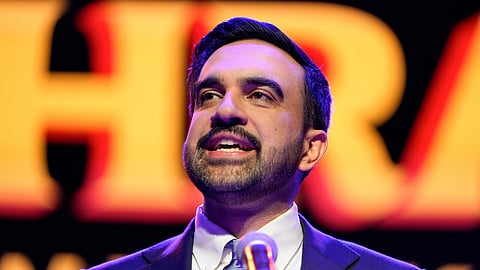

“I contain multitudes,” wrote Walt Whitman, and in Zohran Mamdani’s story, those multitudes seem to acquire living form.
The newly elected mayor of New York City—born of an Indian mother and an Ugandan father, raised in Queens, educated in Bowdoin, and now an American political figure who speaks fluent Hindi and quotes Jawaharlal Nehru—is a walking conversation between India and America. In him converge the legacies of Mira Nair, who brought the fragrance of Indian life to global cinema, and Mahmood Mamdani, whose scholarship has mapped the intersections of power and identity across continents. Together they shaped a son whose worldview is an amalgam of the religious, cultural, and ideological that shapes a migrant identity.
In a time when politics everywhere seems to crystallise difference, Mamdani embodies the opposite impulse: fluidity. He is of Hindu and Muslim descent, Indian and African, American by citizenship but global by imagination—he stands as a reminder that identity is layered and has multiple convergences. When he eats biryani with his hands, plays Bollywood music at his victory lap, or quotes Nehru to a New York audience, he does not do it to parade ‘Indianness’. He does it naturally, unapologetically. That, precisely, is soft power at work—the persuasion of authenticity, not of propaganda.
Soft power, as Joseph Nye first framed it, is the ability of a nation to attract and influence through culture, values, and example, rather than coercion. For India, it has long meant yoga and cuisine, Bollywood and cricket, Gandhi and Tagore. But soft power is also a living thing; it renews itself through people, it perches in the soul. Each generation finds new symbols, new emissaries who, knowingly or not, extend the reach of India’s cultural imagination.
Zohran Mamdani may not ‘represent’ India in any formal sense, yet he reflects some of its finest possibilities—pluralism, intellectual curiosity, and the capacity to juggle contradictions.
Some have responded to this notion with scepticism or even irritation. There are those who say that India’s fascination with Mamdani’s victory is “out of proportion”, that he identifies as Ugandan rather than Indian, that he has criticised the present government and therefore should not be claimed as part of our civilisational fabric. Others go further, and use the uglier rhetoric of communal suspicion.
But this misses the point. Celebrating Mamdani’s story is not about claiming him. It is about recognising the Indian imagination at work in the wider world—the idea that many truths can coexist, that one can be rooted without being lost. His lineage and sensibility mirror the subcontinent’s own civilisational trait: synthesis. We are not a monolith, but a mosaic. From language and cuisine to music and faith, India has always been a sangam of influences—that have come from abroad and which we have assimilated. Mamdani, born of that inheritance and shaped by the pluralism of New York, simply continues the pattern in another register.
It is true, as some critics remind us, that soft power cannot exist in a vacuum. The US projected its culture only after it had secured its military and economic dominance. China, too, is investing in the infrastructure of global power before turning to the subtler work of cultural influence. India’s soft power must therefore be backed by credibility, coherence, and the ability to deliver prosperity and equity at home. Sentiment alone cannot substitute for transformation.
Yet, sentiment has its own force. It is what keeps a civilisation humane. When we speak of soft power, we are also speaking of empathy, of the ability to see oneself in the other. In celebrating figures like Mamdani, we are not imagining a geopolitical triumph; we are asserting a moral one—the endurance of pluralism as a value worth carrying into every corner of the world.
For India, whose diaspora now spans every continent, this moral soft power is both a gift and a responsibility. Each time an Indian-origin figure rises abroad—whether a scientist, a writer, a tech entrepreneur, or a mayor—it reflects how far the idea of India travels. Not the passport, but the idea: the belief that diversity is strength, that contradictions can coexist, that democracy, however flawed, remains a necessary experiment. Mamdani’s ascent may not impact our future, but it speaks to the world about what the Indian ethos, at its best, can inspire.
To dismiss this as romantic is to misunderstand the nature of influence. Romantic imagination catalyses political change. Tagore’s dream of “a world where knowledge is free” became the foundation of India’s global identity. Whitman’s verse about multitudes was poetry before it was political philosophy; it helped define the American creed. Without the romance of inclusion, democracies ossify into tribes.
It is fair, too, to note the shadows. The backlash against diversity in the West is real. Hate crimes against South Asians and Muslims have risen in many societies. Every advance in representation is met with an equal and opposite reaction. Mamdani himself will no doubt face that pressure—and perhaps, as one cynical commenter suggested, will have to navigate it carefully to survive politically. But the existence of prejudice is not an argument against pluralism; it is the reason pluralism must be defended.
When Mira Nair made Monsoon Wedding, she told a story of generational conflict and redemptive tenderness—a family bound together by love despite its flaws. Two decades later, her son’s political journey feels like a sequel in another medium. Where she used film to project India’s warmth and complexity to the world, her son manifests a similar, engaging attractiveness embodying a cultural confidence that does not need permission to belong.
In this sense, Mamdani represents something larger than a mayoralty. He stands at the intersection of two democracies—India and the US—both struggling to renew their promises of inclusion. From India he inherits the faith that pluralism is a civilisational virtue; from America, the conviction that democracy is perpetually unfinished. His story reminds us that these two ideas are not opposites but wayfarers on a shared journey.
To celebrate him, then, is not to appropriate him. It is to see in him a mirror of what both our societies aspire to be—noisy, diverse, argumentative, yet ultimately hopeful. It is to rise beyond cynicism, to celebrate the multitudes we embody.
Whitman’s multitudes were never tidy. Nor is India’s democracy, nor America’s. But both survive because they continue to attract those who believe that belonging is not a zero-sum game. Zohran Mamdani, with his biryani and his Bollywood playlist, his Nehru quotes and New York cadence, manifests that belonging. And perhaps that is reason enough to say, with affection and irony alike—‘Dhoom machale’.
(Views are personal)
(@NMenonRao)
Nirupama Rao
Former Foreign Secretary and Ambassador of India to the US