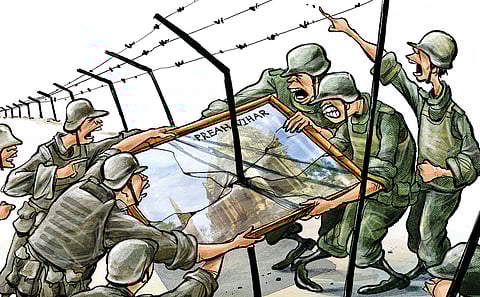

A century-old dispute along the 817-km border between Cambodia and Thailand suddenly degenerated into a military conflict when the world’s eyes were firmly on Gaza. The conflict jolted ASEAN, the regional association focused largely on economic issues. A shooting war over a dispute that includes the ownership of an 11th-century Hindu temple—Preah Vihar, a Unesco heritage site perched on a hilltop overlooking the two Buddhist-majority countries—was unexpected.
Direct talks between the Thai and Cambodian prime ministers, mediated by the Malaysian PM, have resulted in an unconditional ceasefire, though Thailand had earlier rejected third-party mediation. Cambodia alleged that Thailand had agreed to a Malaysian proposal but then backed off, possibly owing to pressure from the Thai military. The Thai foreign minister made the ceasefire conditional on Cambodia showing “genuine sincerity in ending the conflict” and indicated his country was open to dialogue.
The UN Security Council held an emergency meeting to discuss the situation; China and the US also offered to mediate. For Donald Trump, it was yet another opportunity to grandly announce that he had called upon both countries to accept a ceasefire and threatened to withhold trade deals if they didn’t comply. He added slyly that he was reminded of his role in the India-Pakistan ceasefire. Trump seems desperate to shore up his peacemaking credentials that have been severely dented by his failure in Ukraine and Gaza despite threats and deadlines.
In the short and sharp conflict, the two Asian militaries lobbed rockets and artillery shells into each other’s territories claiming self-defence. Thailand deployed drones on Cambodia’s military targets. Thailand, a non-Nato ally of the US, is better equipped with American weaponry; whereas Cambodia’s smaller military is armed with old Chinese and Russian weaponry. An estimated 45 civilians and soldiers were killed and over 2 lakh inhabitants fled their villages near the border.
It was the second skirmish in 3 months since a Cambodian soldier was shot dead after landmine explosions injured five Thai soldiers. Both countries recalled their ambassadors accused the other of “war crimes”. Thailand blamed Cambodia for targeting villages, civilian establishments like a hospital and petrol stations, while Cambodia alleged that Thailand had used banned cluster bombs.
Tensions had been reignited in 2008, too, when Cambodia sought Unesco heritage status for Preah Vihar, leading to violent clashes that caused 28 deaths. This time, Thailand declared martial law along the border and sealed it. Cambodia stopped importing Thai fuel, fruits and vegetables, and banned movies, TV shows and some websites from across the border.
India, which has good relations with both countries, issued a statement: “India... hopes that both sides will take measures for a cessation of hostilities and prevention of further escalation.” Indian embassies in Bangkok and Phnom Penh have issued advisories cautioning Indian nationals to avoid visiting places near the border. Though Thailand is India’s maritime neighbour, the conflict does not pose a security challenge for India.
Simmering tensions over the dispute have persisted since 1907. Both sides blame the former colonial ruler of Cambodia, France, for the poorly-demarcated border running through dense forests dotted with ruins of old temples. Thailand disputes the ownership of the land adjacent to the temples, citing maps drawn by colonial-era French cartographers as inconsistent; Cambodia claims territories that are now in Thailand.
Control over popular temples like Preah Vihar and the smaller Ta Muen Thom are disputed. In 1962, the International Court of Justice awarded Preah Vihar to Cambodia, though the territory surrounding it remained under Thailand’s control. Issues of access for pilgrims and sovereignty have remained a flashpoint ever since. Cambodia views any challenge to the ICJ ruling as an attack on its sovereignty.
The hostilities run so deep that former Thai PM Paetongtarn Shinawatra lost her job when Cambodian strongman Hun Sen released the recording of a phone call with her. In the leaked call, Paetongtarn had called Hun Sen “uncle” and criticised the Thai military leadership for triggering the conflict. She came under severe criticism and was accused of disrespecting national sovereignty.
Regional history paints the conflict in an intriguing shade of blue. Hun Sen and Paetongtarn’s father—another former Thai PM, Thaksin Shinawatra—were long-term friends. Hun Sen, one of Pol Pot’s anti-US commanders during the 1970s, ruled Cambodia with an iron hand for 38 years before giving the reins to his son Hun Manet in 2023. The leak he sprung on his friend’s daughter blew up into a political deluge. The opposition joined hands with the Thai deep state comprising royalists and the military, and accused Paetongtarn of being weak-kneed and critical of the military.
The Pheu Thai party-led coalition government was ditched by its main partner, the Bhumjaithai party. Despite Paetongtarn’s subsequent apology, the Constitutional Court ruled to suspend her as PM and the defence minister took over as the caretaker. It doesn’t help that Paetongtarn, 38, is perceived as a proxy of her influential father Thaksin, who is regarded as the de facto leader of Pheu Thai. She, however, remains in the cabinet as culture minister, a new appointment following a reshuffle before her suspension.
It throws new light on Thailand’s long history of military as well as ‘constitutional’ coups. Since the early 2000s, the country’s royalist-military establishment has overthrown democratically elected governments by weaponising the Constitutional Court, which it controls via nominated members loyal to the deep state. The Constitutional Court has previously ousted three PMs and banned two others from power. Paetongtarn was also suspended temporarily earlier by this court when a case was filed by some senators over the conversation leak.
The Cambodia-Thailand conflict poses a dilemma for China. Beijing has invested heavily in both countries’ infrastructure. It has a large naval base in Cambodia, which is crucial for its high stakes in ASEAN. No wonder it has adopted a “just and impartial position” and has said it would promote peace talks. Meanwhile, there is intense speculation over a covert American role in stoking the conflict that refuses to die down, as the US uses various levers to constrain China geopolitically in Asia.
Pinak Ranjan Chakravarty | Former Secretary, Ministry of External Affairs, and former Ambassador to Thailand
(Views are personal)