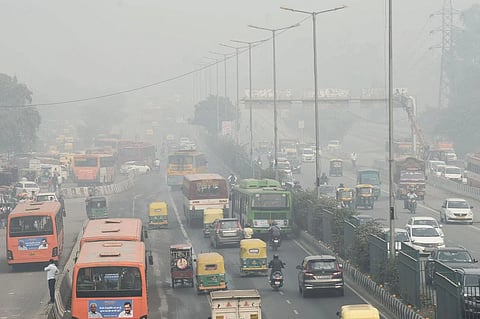

Morning dawns in Delhi.
It feels like the clock has been set back, like we are in a different dimension: the city is covered in a soupy pall. The smog blocks out the sun at one of the nicest times of the year. I hold my breath.
Morning dawns in Bengaluru.
As the hour ascends, the sky is a solid blue, smooth lacquer, like a handmade Persian tile on a monument. The air fills all my senses, in the manner of sparkling champagne. I breathe fully and deeply.
Back in North India, I think about our collective predicament: bad air is a public interest issue, but it increasingly forces so many of us to get hermetically sealed—in our own air bubbles, so to speak. We turn in to protected, purified cars, homes and offices, away from each other, away from the outdoors. Runners postpone their sport, birdwatchers delay their excursions. The poor suffer yet another indignity heaped on to their lives. And it is not just cities—it is entire regions in various parts of the country that exhaust themselves with poor air quality.
Meanwhile, the humour, like our air filters, is black. Politicians have various gimmicks and explanations. Air data goes missing. My air purifier says ‘FO’ to me. Stepping out without a mask feels like an endurance sport.
When we watch movies with animal characters, people often ask: does the animal know he is in a movie? Like animals (unknowingly) starring in horror films, the very old and the very young live in an air dark with the lack of consent.
There are many bold political moves that are needed, which need to be decisive—electrification of transport, moving industry, postponing construction (and marathons). At the moment, environmentalism feels expensive, almost like a luxury commodity. Just like biodegradable plastic bags are expensive (as compared to regular plastic garbage bags), costly electric vehicles may make you feel the polluting familiar, the regular car, is an easier choice. Perhaps an aggressive exchange offer for electrified vehicles is the place to start.
At this clouded time, I think of the personal. There are new cultures of care and new vocabularies that have emerged. Do you have your mask? A friend asks. Can I order you a new HEPA filter, I am getting some for myself, says another. Everyone brings indoor plants as gifts. Somebody checks if we are still drinking kaadha, a concoction for the throat. Someone else suggests drinking not plain water, but glasses of water with tulsi (basil) and slices of amla. It is like everything needs an extra shot of immunity, like Covid never went away and our faces will forever be sheathed in masks.
How far does one have to travel before the air is clean enough for breathing to feel invigorating, and not diseased? It is like searching for the spot in the mountains where one finally, exhilaratingly, views the snowline.
A hundred kilometres from Delhi is where the air is clean, I told my friend. Right into the sea, on a boat (off Mumbai’s coast) is where you can really feel the sea air, she responded to me. We were tallying our personal ‘snow-lines’—the places where nature felt more powerful and more moving than everything we had done to it. The week trundled on, and we waited for our snow-lines.
Views expressed are personal