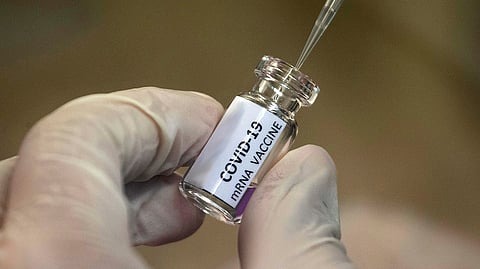

The US Food and Drug Administration (FDA) is seeking to propose a stricter vaccine approval protocol after an internal memo linked COVID-19 shots to the deaths of a few children -- a move experts criticised as "irresponsible" and "dangerous."
The email -- which included a 3,000-word memo -- accessed by several US media outlets and written by Dr Vinay Prasad, director of the FDA’s vaccine division, claimed that a recent review found at least 10 children had died "after" and "because of" receiving a COVID-19 vaccine, linking the deaths to myocarditis, an inflammation of the heart muscle.
Prasad, a prominent critic of the pharmaceutical industry and the FDA, has seen his controversial vaccine policy views backed by Health Secretary and vaccine skeptic Robert F Kennedy Jr. In his memo, he told FDA officials the agency should tighten its vaccine approval process in light of the review.
According to the Washington Post, Prasad said the FDA intends to reassess its framework for annual flu shots, examine whether Americans should receive multiple vaccines at the same time, and require manufacturers to submit far more data to demonstrate safety and effectiveness.
He also argued that pneumonia vaccine makers should be required to show their products reduce actual pneumonia cases, rather than merely increase antibody levels.
According to the New York Times, Prasad wrote in his memo to staff that the FDA, "for the first time", "will acknowledge that Covid-19 vaccines have killed American children" and called it "a profound revelation."
Prasad added that he remained "open to vigorous discussions and debate", but said staff who did not agree with the core principles of his proposed approach should submit their resignations.
Prasad said he will propose a series of new oversight and review measures for vaccines. However, NTY reported that it was unclear whether the White House had been briefed on its contents, adding that the proposal could still be revised by administration officials or face pushback from lawmakers and pharmaceutical companies.
Experts decry dangerous vaccine claims
Prasad's memo marks another escalation of attacks on vaccines under RFK Jr., who has used his role as health secretary to repeatedly cast doubt on inoculations and appoint other skeptics to key positions.
Experts across federal agencies, academia and public health raised sharp concerns about Prasad’s claims and proposals, warning that they risk undermining long-standing vaccine standards.
Current and former FDA officials and outside specialists told Washington Post that Prasad’s recommendations would upend decades-old approval norms by forcing manufacturers to run significantly larger studies, a shift they said could slow development and deter innovation.
They also noted that his questioning of simultaneous vaccinations contradicts years of federal guidance on childhood immunisation schedules and adult respiratory vaccines.
Jesse Goodman, who once led the FDA’s biologics division, said existing rules are already "quite strict", adding that, "It’s not like these things are being approved without strong scientific evidence. They’re being approved with strong scientific evidence."
Goodman told NPR that the FDA’s biologics division remains "recognized globally as a gold standard regulator", defending the use of immune-response markers for accelerated approvals and noting that they are verified in post-approval studies.
Meanwhile, NBC News reported that several experts accused the memo of misusing VAERS, an unverified reporting system that can contain "inaccurate, incomplete or biased information."
Dr Paul Offit, a pediatrician and the director of the Vaccine Education Center at the Children’s Hospital of Philadelphia, called the memo "sort of science by press release", describing it as "irresponsible" and "dangerous."
In comments to NPR, Offit said Prasad had not provided evidence to substantiate the claim that vaccines killed 10 children: "Because he doesn’t provide any evidence, he is asking us to trust him on an important issue. All this will do is scare people unnecessarily."
Prasad’s predecessor Dr. Peter Marks, who was the FDA’s former vaccine chief, said the agency’s interpretation of the database drew directly from the "anti-vaccine playbook."
Marks, after reading the memo, told NYT that he was struck by the "clearly political tone of the communication" and cautioned that the reported childhood deaths may ultimately prove inconclusive.
"I would not be surprised if the attributions turn out to be debatable, as these cases are often quite complex," he remarked.
Similarly, Michael Osterholm, an epidemiologist at the University of Minnesota, challenged Prasad’s assertion that COVID was never highly lethal for children and questioned the FDA’s analysis attributing 10 deaths to vaccines. He noted the cases have "never been presented for review" and said that until an independent third party examines them, "we can not accept the fact they are vaccine-associated deaths."
The NYT reported that Osterholm also criticised the memo’s timing, saying it appeared deliberately released ahead of internal meetings. "This is an irresponsible way to deal with a very critical public health issue like vaccination and adverse events," he said.