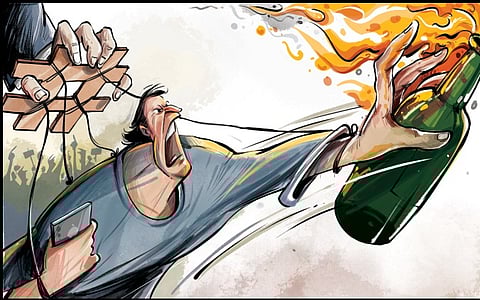

South Asia stands on the edge of a precipice powered by the ambition and angst of its young people. With half of the region’s two billion people under 24 years of age, it is really moot whether the demographic dividend subsists or has morphed into a nightmare.
For millions in the younger generations, it is almost impossible to find quality work or articulate their yearnings in an evocative manner on the public affairs of their Westphalian entities. Rather than becoming catalysts of transformative change, these young people have become unwitting instruments of instability and undemocratic regime change.
Every day, a new cohort of about 100,000 young South Asians look for work, but the economies do not offer enough opportunity. The skill gap is devastating: 93 million children remain out of school, nearly three-fifths cannot read till age 10, and almost a third are neither in education, employment, nor training. This explosive combination of high aspirations created by dazzling media feeds and limited state capacity creates a lethal Molotov cocktail that propels spontaneous mobilisations at a mega scale.
Unlike regions that trade and connect freely, South Asia remains one of the least linked in the world. Intra-ASEAN trade in 2024 was $752.5 billion while intra-South-Asian trade stands at a meagre $23 billion. This keeps economies stagnant and lets discords fester, thereby ensuring that the creative energy and potential of the region remain stifled and susceptible to the machinations of malefic external interests.
Hillary Clinton’s book Hard Choices has a whole chapter revealing that the Arab Spring of 2010-11 was not as organic as it seemed at first, but had activists schooled in technology camps run by Western powers. As Clinton’s senior adviser Alec Ross admitted, the US state department collaborated with tech firms to shield protesters while instructing activists in online subversion methods. The apprehension that authoritarian states had that the Internet would be weaponised to “foster regime change” was indeed prophetic.
South Asia is now the new battleground. In 2024, Bangladesh’s Sheikh Hasina alleged ‘the hyper power’ had indulged in subversion after she refused to hand over St Martin’s Island, a skerry with gargantuan strategic significance. In the blink of an eyelid, she had to flee.
China has been quietly neo-colonising South Asia with its Belt and Road Initiative. Ports in Sri Lanka (Hambantota) and Pakistan (Gwadar), the Coco Islands off Myanmar and the Kyaukphyu port are its crown jewels. Major chunks of infrastructure in Bangladesh, Nepal, Sri Lanka, and Maldives are now resourced by the Chinese who are also courting Bhutan aggressively.
In this larger geopolitical context, the glaring inequality in South Asia is portentous. The entitled progeny of the political elite and corporate oligarchs’ flashy lifestyles on social media contrast sharply with the subsistence employment that most young South Asians have to chase.
The contrast manifests online. Viral posts of debauchery and ‘excess of the entitled’ explode across social media platforms every day, inviting scrutiny and stoking anger. Resentment coalesces into protests that can be amplified by foreign tools. Social media platforms controlled by foreign companies amplify such demonstrations, blurring the lines between genuine protest and engineered unrest.
The recent mega protests in Sri Lanka, Bangladesh, Nepal, and now in the Philippines illustrate how social media weaponises organic gripes into revolutionary movements. Sri Lanka’s Aragalaya (The struggle) movement organised using hashtags such as #GoHomeGota targeting Mahinda Rajapaksa and his coterie for gross economic mismanagement and personal profligacy.
Bangladesh’s student-led demonstrations that compelled Hasina to flee Dhaka started as quota protests but soon escalated through social media mobilisation. The transference from focused policy protests to regime change happened at lightning speed once activists changed their framing from reform to anti-fascism, using platforms such as Facebook and Twitter to organise nationwide protests.
Nepal’s Gen Z uprising rode the #NepoKids hashtag, focusing on politicians’ children who boasted of ostentatious lifestyles while young people struggled against hopelessness and exploitation. Videos of the progeny of ‘political elites’—the neo-monarchs living it up in a vulgar display of wealth acquired through illegitimate means went viral.
The government’s move to prohibit social media platforms pushed online outrage onto the streets a la Tahrir Square. It became a one-way ticket for Prime Minister K P Sharma Oli and other political monarchs of Nepal. The anger was an equal-opportunity leveller sparing neither the rulers nor the co-opted opposition.
The frequent foreign jaunts to exotic locales of #Nepokids without any legitimate source of income and evisceration of the distinction between personal finance and the State/political party purse underscored a sharp inflection when juxtaposed against millions of young Nepalese struggling to keep their bodies and souls together with menial jobs in foreign lands.
The Philippines saw the same dynamic with the ‘Trillion Peso March’ rallying masses against dynastic politics and infrastructure thievery. Mass mobilisation marking the 53rd anniversary of martial law symbolically connected modern-day corruption with past authoritarianism of the Marcos dynasty.
The calling out of the entitled political elite led to an explosion of pent-up angst. Sophisticated digital synchronisation using platforms like Discord and TikTok successfully channelled online outrage into street-level mobilisation. The rapidity of these transformations in weeks is evidence of the omnipotent foreign hand.
Chaos helps big predatory powers to convert vulnerable nations into client states. The local youth are their cannon fodder, exploited for ‘games’ beyond the protesters’ comprehension.
Until South Asian nations close the gap between aspirations and capacity, bury the spectre of entitlement, and bid adieu to the neo-monarchs, the region’s vast youth bulge will remain vulnerable to anyone with the resources and willingness to uncork their frustration for neo-colonial gains.
Manish Tewari | MP, lawyer, and former Union I&B minister
(Views are personal)
(manishtewari01@gmail.com)