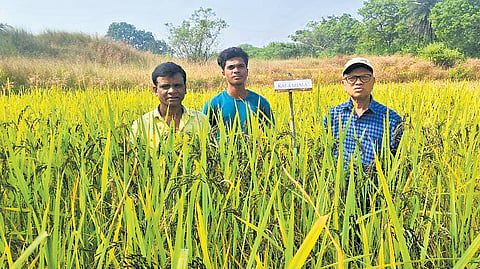

SUNDARGARH: Is hard and long hours of toil in the fields have not brought him a comfortable income. Yet, he has persevered with an unyielding purpose to preserve his tradition, particularly the indigenous seeds and natural farming practices of his forefathers.
The very conviction to revive and popularise organic and natural farming has earned a distinct identity for the tribal farmer Surath Kisan (51) of Dharuadihi village under Ledimand panchayat of Sundargarh district. He is regarded as the most-committed and leading organic farmer, a custodian of indigenous seeds and a trainer for other farmers in the tribal-dominated district.
Over the last 11 years, Kisan has built a collection of about 138 indigenous seeds, among them are rare varieties of paddy, oilseeds, vegetables and millets. In the last six years, he has trained around 4,500 to 5,000 farmers in organic and natural cultivation, steadily widening the circle of growers turning away from harmful chemical-based methods.
Kisan has spent the past 13 years practising chemical-free farming on his five-acre plot. He cultivates paddy, oilseeds and pulses, tending his land with the same persistence that has shaped a transformation in farming practices in his region. “I belong to a tribal agrarian family. My elders were rich with the knowledge of natural farming, but things gradually changed for the worst. My family too swayed towards modern farming methods in the lure of high-earning. This was not possible without use of high-yielding or hybrid seeds, chemical fertilisers and pesticides,” he says.
“I realised about the damage to our knowledge of natural farming and environment along with extinction of indigenous seeds after attending an awareness programme of the Desi Bihan Suraksha Manch (DBSM) during 2012. It was a turning point for me.

I got associated with the organisation and returned to organic/natural farming. From 2014, I also started conserving indigenous seeds,” he adds.
Today, he has around 110 varieties of indigenous paddy seeds including five each of black and red rice, seven types of aromatic rice and four types of long-grain rice along with 18 varieties of millet seeds and 10 vegetable seeds. Few among the long-grain rice seeds with him include Sunakathi, Kendrajhal, Sapuri and the black rice seeds include Kala Malliphul, Kalabati and Piuritan. The aromatic rice seed varieties have Karpurkanti, Gahamphul, Samleibhog, Kalajeera and Dubrajbhog.
Preserving these indigenous seeds is no easy task. For the sake of conserving the seeds, Kisan raises a nursery on a farm plot of about 50 decimal every year. He is supported by his wife in his endeavour. And bit by bit, he has accumulated a treasure of indigenous seeds that were on the path of extinction.
“The seeds I have managed to save and also revive vary from 1 kg to 100 kg. I distribute them among the farmers. Sometimes, they seek large quantity of paddy seeds for which I charge a nominal amount. For others, I share the seeds on condition that they return the same quantity they take after their harvest,” says Kisan.
He says he doesn’t earn much from it and the money also doesn’t matter much for him. “It is the satisfaction and the sense of achievement on keeping our indigenous seeds and farming practices alive that keeps me going,” he says.
Besides providing seeds, he is also hands-on in training the farmers on appropriate use and farming techniques to gain maximum output. So far, he has trained 4,500-,5,000 farmers in Sundargarh, Jharsuguda, Nayagarh and Nuapada districts. “I devote 40-50 days for training in a year and manage to earn honorarium of `40,000-`50,000,” he reveals.
The convenor of DBSM Saroj lauded Kisan’s dedication to his work. “He is ideologically motivated and puts in hard labour and cost with the only aim to prevent indigenous seeds from vanishing,” he says.
Sundargarh chief district agriculture officer LB Mallick said the world is slowly recognising the value of organic farming with indigenous seeds for chemical-free food production. “Many tribal farmers across the district still grow crops with traditional knowledge and natural inputs. The efforts of Kisan would motivate others to do better,” he says.