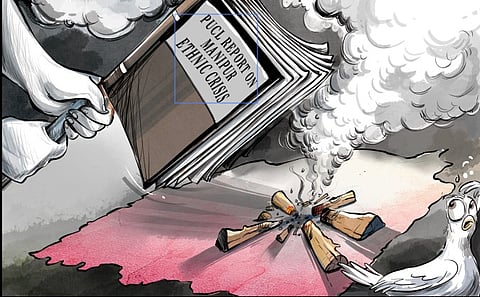

The nearly-700-page report on Manipur’s ethnic crisis by the People’s Union for Civil Liberties or PUCL has two cautionary notes for research writing and publishing. One, written and published words tend to live on even after their contents have been proven inaccurate or false. There are always some who would cite and give them new life. Two, in motivated research, the legal principle of audi alteram partem, or hearing all parties before making judgement, is often forsaken. The PUCL report is replete with instances of both.
Two examples should illustrate the point. On page 362, a testimony by an unnamed Meitei journalist claims: “We have a journalists’ union, the All Manipur Working Journalists’ Union (AMWJU). This union has a decisive role—on how to carry a story, how to kill a story. It operates like ‘godi media’ and they are pro-Biren Singh.”
Another voice adds that there are journalists who refuse these consensual lines, indicating he/she is one such: “I have been warned, threatened, a gun has been put on my head,” adding he was arrested twice, and cases were slapped on his organisation. He further indicates his membership with AMWJU was rejected as his organisation was not recognised by the union on the point that only “private limited companies can run TV channels and digital media”.
Considering that these allegations are slanderous, should PUCL not have given AMWJU a chance to explain before publishing these voices?
This columnist is familiar with the background of these issues. For instance, the stipulation of admitting digital media journalists only if their employer organisation is a private limited company is not an independent policy of AMWJU, but it leans on a November 30, 2022 order of the ministry of information and broadcasting.
The order says only private limited firms running ‘multi-system operators’ can apply for an I&B ministry registration. AMWJU used this to deal with the problem of accommodating an exponentially increasing number of journalists in an age anybody with a smartphone can claim to be a journalist.
On the allegation of AMWJU setting consensual standards for news coverage, this is not for all news and happens especially in coverage of factional fights between insurgents. Member journalists sit together to decide how or whether to carry such news, and stand together so that no one ends up alone to face coercion later. Outrageous as this is, it has to be understood as a coping mechanism in a prolonged conflict situation.
The other red flag is the tendency of perpetuating published ideas even after they have been proven false.
For example, the PUCL report refers to a September 2022 report on the Manipur crisis by the Editors Guild of India to claim that declaration of reserved and protected forests has been weaponised to target one community (pages 108 and 320). When the EGI made this allegation, a signed clarification was issued by the then principal chief conservator of forests, S S Chhabra, explaining there was no recently-declared reserved or protected forest in Manipur. The latest declaration for a reserved forest was on January 4, 1990, and for a protected forest on June 18, 1979. This clarification has been ignored in the PUCL report.
On page 300, the report deals with the case of the Churachandpur-Khoupum protected forest. It claims that 38 villages originally in this 499.06-sq-km forest that had been declared in 1966 were set to be evicted as encroachers. The same principal chief conservator’s clarification had explained that this, too, was untrue.
In 1972, a forest officer ‘set aside’ these 38 villages, though there is no provision for such action in a protected forest. This ultra vires setting aside was what was sought to be annulled by the principal chief conservator in a November 2022 order, which the PUCL report cites as ‘discriminatory’.
This annulling, however, does not mean the 38 villages will face eviction, for existing villages in a protected forest are allowed to remain where they were. The problem, on the other hand, is that the number of villages in the Churachandpur-Khoupum forest has grown from 38 in 1966 to 191 now. The new villages, hence, can face the prospect of eviction. Poor research rigour also makes the PUCL report confuse the difference between a protected and a reserved forest.
No habitation is allowed within reserved forests. Hence when a forested area is notified as potentially reserved and there are claims of villages in the proposed area, a settlement officer has to confirm the claims and then either ‘set them aside’, so they are no longer inside the area, or acquire them after paying due compensation. By contrast, in a protected forest, human habitation is allowed; so the question of ‘setting aside’ does not arise.
The thumb rule is that in reserved forests no human activity is allowed except those expressly permitted by the forest authorities, and in protected ones, all activities of the existing villages are allowed except those expressly prohibited by the forest authorities. All these had been clarified, but none of it is reflected in the PUCL report.
On the matter of eviction, the official figures are revealing. Between October 24, 2015, when the eviction drive began, and April 18, 2023, when the last eviction took place, there have been a total of 413 households moved out from 24 reserved and protected forests. Except for a few, such as K Songjang in Noney district, all others are in valley districts. Community-wise, count of evicted households falls as Kuki 59, Meitei 143, Meitei-Pangal 137, Naga 38, and Nepali 36. This does not suggest any targeted victimisation that the PUCL report presumes.
Selective use of vocabularies also indicates a motive. For example, one community is ‘thrown out’ of the valley, but the other ‘left the hills’ (page 22). Technically, they may mean the same, but a bias is apparent. The report also says Meiteis are restricted from buying land in the hills. Reciprocally, hilly tribal communities are restricted from buying land in the valley (page 612). This is a sinister half-truth.
The trouble is, activists for whom anti-establishment posturing is vital tend to be prone to wokeness, absorbing only what endorses their preconceived views and cancelling those that challenge them. The PUCL report, rather than healing, has reopened old wounds.
Pradip Phanjoubam | Editor, Imphal Review of Arts and Politics
(Views are personal)
(phanjoubam@gmail.com)