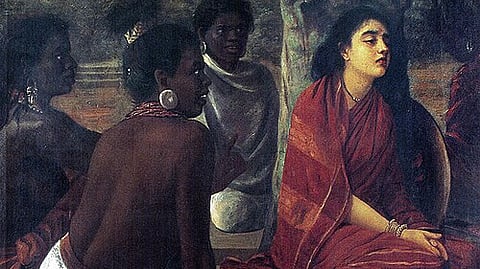

In the delicious interlude between Diwali and Dev Diwali, or Kartik Poornima, that’s coming up on November 5, the thoughts of many devotees may frequently dwell on the abundance of Mahalakshmi. So, it seems appropriate to talk a little about her. Perhaps what we miss in popular calendar images of Mahalakshmi showering gold coins nowadays is the compassion in her gaze. And if we looked again at Raja Ravi Varma’s images of Sita Devi, the avatar of Mahalakshmi, we could see her soft gaze, which the painter intuitively captured and shared with us.
Valmiki highlights this quality of Sita’s innate compassion in the Ramayana. Trijata, the only nice rakshasi in the Ashokavana, has a vivid dream in which she sees Sri Rama conquering Lanka. When she warns the horde of nasty rakshasis not to torment Sita further because Rama will come to finish them off, Sita’s reaction is remarkable. She tells Trijata, “They are only employees, poor things, who are following Ravana’s orders. I will protect them! Tell them they will come to no harm.”
Queenly? Goddess-like? It’s all of a piece if we consider the history of Mahalakshmi in Indian culture. Adi Shankara believed that the individual soul or jivatma was not separate from but part of the supersoul, the paramatma. The journey of human life was therefore the struggle of the jivatma to be reunited with the paramatma. Nobody could fight against malignant fate except by working off bad karma. But he said—and this ‘but’ is deeply entrenched in the culture—only Mahalakshmi has the power to rewrite a person’s destiny through her compassion.
This belief is evident in the famous story of how Shankara, as a very young bhikshu, invoked Mahalakshmi on behalf of a wretchedly poor woman. He praised her in twenty-one beautiful verses, describing Mahalakshmi as the goddess in whom he saw all the goddesses as one, calling her, among other lovely epithets, “sarasija nilaye, saroja hastey”, meaning “seated on a lotus, with a lotus in her hand”. This vision links with our earliest known book, the Rig Veda. Mahalakshmi is described as sarasija nilaye saroja hastey in the Sri Suktam, part of the Rig Veda Samhita, a collection of mantras and slokas.
Shankara sang, “Let her garland of glances that protect Lord Vishnu fall on me as well…Gracious goddess, giver of love, giver of joy, giver of wealth, giver of the right to rule kingdoms, be merciful as the cool breeze. Shower a rain of wealth on this parched land.”
The legend goes that the goddess blessed him with a vision of herself, and Shankara pleaded with her to restore the abjectly poor mortal woman to dignity with enough resources to live on. When Mahalakshmi disclosed that she couldn’t do that because the woman had been a miser in her last birth who gave absolutely nothing to the poor, Shankara earnestly pointed out that in this birth, though she was starving, she had given him alms—a gooseberry, the very last thing she had left. “Mother, you know very well that only You have the power to change the destiny written by Lord Brahma on each person’s head,” he cajoled.
“So be it,” said the goddess, not only charmed by the little bhikshu’s poetry but also amused by his boldness and sincerity. As her vision vanished, a shower of golden gooseberries (our gods have a quirky sense of humour) fell into the poor woman’s hut. Shankara’s verses became known as the Kanakadhara Sthavam or the Litany of the Shower of Gold. Even today, it is both sung in public and recited at home, and if you would like to hear a benchmark rendition, do look for M S Subbulakshmi’s recitation on YouTube.
During the post-Shankara period, Indian religion and culture received a rude shock from foreign invasions. In the 14th century, a learned sanyasi, Swami Madhava Vidyaranya (1296-1386), decided to protect South India from the foreign invaders operating out of Delhi. He inspired the two brothers Harihara and Bukkaraya to build a city and establish a new kingdom. Thus, the Vijayanagar Empire was founded in 1336 and served as a bulwark for 300 years against marauders from the north. This allowed the South to experience a historical, cultural, and socio-economic revival unlike anywhere else in India at that time.
Vidyaranya Swami was a staunch Advaitin or follower of Adi Shankara’s Advaita philosophy. He mentored three generations of Vijayanagar’s rulers, and ‘retired’ as the Shankaracharya of the ancient Sringeri Matt. His philosophical work, Panchadashi, is still very much in vogue and is distributed, read, and discussed in spiritual circles.
With this background, there is no way that he would not have prayed, along with Harihara and Bukkaraya, to Mahalakshmi from the Kanakadhara Sthavam. Especially the verse, “Gracious goddess, giver of the right to rule kingdoms,” invoking her compassion and grace for his just and worthy cause. He was duly rewarded, as history testifies.
Another great scholar of the time, Vedanta Desika (1268-1369), lauded Mahalakshmi’s compassion in his Daya Satakam, the Hundred Verses on Mercy, addressed to the goddess and Lord Vishnu at Tirupati. It is she who controls the Lord’s actions by her goodness and mercy, he averred.
It was not just these great historical figures who adored Mahalakshmi. She was and remains deeply beloved among the common people. Women are known to have a particularly tender relationship with her as the Divine Mother who grants happiness and well-being. That is the ‘real’ Lakshmi, not merely a persona invoked for more money.
Renuka Narayanan | FAITHLINE | Senior journalist
(Views are personal)
(shebaba09@gmail.com)