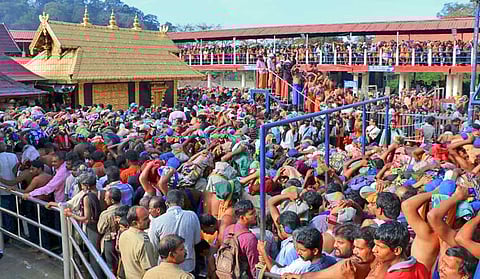

The first World Ayyappa Convention, backed by the CPI(M)- led Kerala government and presided over by the Travancore Devaswom Board (TDB), took place in Pamba near Sabarimala on Saturday. Many allies of the CPI(M)—who face an assembly election next year—were part of the event. Every politician loves a rich god.
In late 2022, the TDB was caught in a scandal. Gold ornaments offered to Lord Ayyappa by devotees over decades were sent for remodelling to a goldsmith in Thiruvananthapuram. When they were returned, their weight had lessened considerably. The TDB claims the difference is only about 4 kg—standard wastage from refining. However, critics, including a temple advisory committee member, allege that up to 90 kg of material is missing, suggesting the gold was either stolen or swapped with inferior metal.
The Crime Branch, which comes directly under Chief Minister Pinarayi Vijayan, is investigating the case. Naturally, it is not in a hurry to conclude its findings. The case is once again at the centre of state politics, with the opposition interpreting the convention as a cynical exercise to win over believers and convert bhakti into the only thing of political value—votes.
God is big business. Sabarimala attracts over 20 million devotees in a typical pilgrimage season. The TDB’s annual income from the shrine is estimated to be well over ₹500 crore. This is admittedly less than the income of the Sree Krishna Temple in Guruvayur, which has an annual footfall of 8-10 million but generates an estimated ₹600-800 crore, thanks to its year-round operations and gold reserves of approximately 2,500 kg.
To put the temple business in perspective, both these rich temples in Kerala are inferior in income and influence to the titan of temples in India, Tirumala Tirupati. The Tirumala Tirupati Devasthanams oversees 25-30 million annual pilgrims, stores over 9 tonnes of gold, and collects over ₹1,500 crore in yearly donations.
Another prominent Kerala temple in the news is Sree Padmanabhaswamy in Thiruvananthapuram. In 2011, the opening of the temple’s ‘Vault B’ unveiled a treasure of gold, diamonds, and artefacts valued at about ₹1.2 lakh crore, making it one of the richest places of worship in the world. These are India’s gods of gold. Can politics be far behind?
As of now, a Supreme Court-nominated committee manages the Padmanabhaswamy Temple’s affairs, including its finances and security. This is seen as a working compromise reducing the direct control of both the royal family and the state government, the main contestants for managing the funds.
A fraction of temple funds is used for philanthropy. The Tirumala authorities run hospitals and universities. In contrast, the Kerala temple boards’ charitable output is perceived to be minimal. For example, nothing ought to prevent them from running good hospitals for the poor, yet there are few such institutions.
The vast majority of temple wealth disappears into a labyrinthine ecosystem of administrative overheads, opaque fixed deposits, non-transparent tenders for everything from ladles to laddus, and real estate deals. The boards governing these temples are often vicarious centres of political patronage, where appointments are rewards, not responsibilities. The annual audit reports, when they see the light of day, are often chronicles of compromise.
The Sabarimala case is exceptional because of its direct nexus with politics. The TDB, which manages over 1,200 temples, is currently headed by a leader of the CPI(M), a party in power for nearly eight consecutive years. One might ask: what has Marxism to do with Manikantan (another name for Ayyappa)?
The 90 kg vs 4 kg debate is not a simple accounting error. It is facetious to claim a considerable quantity of gold simply evaporated. After years of investigation, if the Crime Branch cannot determine the weight of the missing gold, it is a symptom of the disease. The TDB’s version of events is a testament to their belief that the faithful would swallow any explanation, no matter how implausible.
They forget the lesson taught by rationalists like the late Pavanan, who happens to be my father. A rationalist all his life, decades ago he exposed the ‘divine’ Makara Vilakku ‘miracle’ as a man-made fire, orchestrated by the devaswom board. Makaravilakku is an annual event celebrated at Sabarimala marking the culmination of the pilgrimage season. The festival is famous for the sighting of a special light, the Makarajyothi, on the top of a distant hill. Pavanan and his colleagues discovered that the fire was lit by the temple management. He proved that the machinery of faith is often powered by falsity. Yet, the Makarajyothi spectacle continues.
Those who believe cannot question. Politicians and power brokers know this well. Why would an all-powerful god, who created the stars and Earth, want gold and cash? No politician, national or Kerala-specific, would ask that question because power must build bridges with superstition to survive.
The devotee does need to know that their sacrifice—the hard-earned cash dropped into the hundi, the gold necklace offered in desperation or gratitude— is treated with a measure of sanctity. Perhaps our billionaire gods cannot be brought to book. But the dealings of the politicians who pretend to be their managers can be made more transparent.
C P Surendran | Poet, novelist and screenplay writer whose latest T novel is One Love and the Many Lives of Osip B
(Views are personal)
(cpsurendran@gmail.com)