
The ‘family photo’ from the White House after an almost-90-minute meeting last Thursday between the US President Donald Trump, Pakistani Prime Minister Shehbaz Sharif, and Chief of Army Staff Field Marshal Asim Munir would have stunned the Indian foreign and security policy establishment. Things are getting to be very serious indeed.
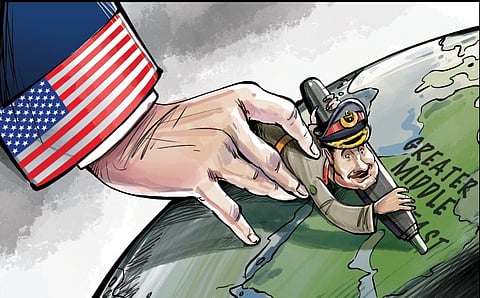
That the meeting was a foreign policy strategy session is apparent from the presence of two other participants—Vice-President J D Vance and the Secretary of State and acting National Security Advisor Marco Rubio, who form the core group in Trump’s foreign policy team. The event underscored the high importance Trump attaches to a constructive partnership with Pakistan in the geopolitical arc of what Americans traditionally called the Greater Middle East—stretching from the Levant to the Persian Gulf and Central Asia including Afghanistan.
Trump’s first term as president ended with a foreign policy ‘scoop’ in 2020—the Abraham Accords, aimed at Israel’s integration into its Muslim neighbourhood. But the four years since have witnessed phenomenal changes in regional politics—in particular, the October 2023 attacks on Israel and the ensuing Gaza war that has resulted in Israel’s regional isolation, a diplomatic rapprochement between Saudi Arabia and Iran, and Iran’s surge as a nuclear-threshold state. All of this has significantly eroded American influence in the region, as evident most glaringly in the BRICS membership of Egypt, the UAE and Iran, and even Saudi Arabia just outside the tent looking in.
By hedging its bets, Saudi Arabia called attention to its acute need of improved security and political relations by diversifying its network of international partners and its assertion as an independent regional powerhouse. Trump took note of it when he picked up the threads where he left them in January 2020, and prioritised the Saudi demand for a defence pact to safeguard its security and a peaceful nuclear programme to match Iran’s.
Unsurprisingly, neither the US nor Israel has condemned the Saudi-Pakistan defence pact. Trump received the Pakistani leaders, civilian and military, within a fortnight of the signing of the pact. Iran has been left to figure out that in any future war with the US, retaliation against American attack would need to exclude Saudi territory, especially Saudi oil fields and assets in the Persian Gulf.
Suffice to say, both Washington and Tel Aviv visualise the Saudi-Pakistan pact as a cornerstone of the New Middle East emerging against the backdrop of an unrestrained Israel, a wounded Iran, and an unpredictable US.
The Saudi-Pakistan pact was a few years in the making and it should not be seen as a reaction to the present moment. But it can be regarded as a response to the broader tectonic shifts in the region—a moment where both Saudi Arabia and Pakistan need to create options for themselves.
Of course, the two countries have been intertwined for decades. Pakistan’s long road to the nuclear club was paved with Saudi petrodollars. Pakistani troops were deployed on Saudi Arabia’s northern border during the Iran-Iraq war. Saudi money for Afghan Mujahideen was routed through Pakistani intelligence. Pakistani military advisors help train the Saudi military; a former army chief commands the Saudi counter-terrorism force. That said, Pakistan’s relationship with Saudi Arabia has not always been smooth. Pakistan refused to join the Saudi-led air strikes on Yemen in 2015. Again, Saudis have long sought nuclear technology from Pakistan.
For Trump, an American presence in Afghanistan is vital for advancing the containment strategy towards Iran. But recently, the Taliban rebuffed his demand that the Bagram air base be under US control. The US is left with no option but the ouster of the Taliban government. The only country that can deliver on Afghanistan is old ally Pakistan, which also views the Taliban in hostile terms.
Notably, just three days after the Pakistani military chief ’s meeting with Trump and his team in the White House, Taliban authorities have abruptly capped fibre-optic internet access in the country. Telephone communications in Afghanistan are largely routed through the country’s fibre optic network; hence the shut-down has affected mobile and fixed-line telephone services as well. Conceivably, Taliban is circling its wagons, sensing danger. Shades of Generation Z protests? Afghan resistance has ties with Western intelligence.
A third dimension to the Saudi-Pakistan pact is the role the Pakistani military can undertake as an ‘Islamic’ peacekeeping force in Gaza under the 20-point plan that is based on a Saudi blueprint, which Trump has unveiled as a personal initiative. The plan proposes that Hamas’s rule in Gaza would end and be replaced by a ‘technocratic, apolitical Palestinian committee’ that would be overseen by a supervisory Board of Peace led by Trump as chairman.
The Pakistani military enjoys a high reputation for its professionalism and would have wide acceptability both in the West and the East, besides the Muslim world, to be the lynchpin of the post-war normalisation process in Gaza. Trump has big plans for Gaza with huge business spin-offs that could fuel MAGA.
If the 20-point plan takes off, Trump will have taken a big step in reviving the Abraham Accords, leading to Saudi-Israeli ties—and, possibly, Pakistan-Israel diplomatic relations, too. Trump has brought back his son-in-law Jared Kushner, who had previously played a role in shaping Middle East policy. Kushner, a Jew and a businessman, is well-liked by the Israelis and the Saudis. His return will be a confidence-building measure for Israel. It cannot be a coincidence that videogame maker Electronic Arts is going private in a massive $55-billion deal unveiled on Friday that is funded by a US-Saudi consortium led by Saudi Arabia’s Public Investment Fund and Kushner’s Affinity Partners. Reportedly, they are paying $210 a share, making it the largest buyout on record.
The bottomline is that Field Marshal Munir is going places. And this has profound implications for India in terms of the efficacy of our ‘hug diplomacy’ with Trump and Operation Sindoor in particular. Make no mistake, Munir is going to be a key figure in Trump’s ambitious MAGA project, packaged as the making of a New Middle East.
M K Bhadrakumar | Former diplomat
(Views are personal)