
The seed of this column was planted exactly 14 months ago. I was delivering the inaugural keynote address at an offsite in Udaipur for an IT firm of repute. There were 350 people in the audience from the key client-facing realm of bleeding-edge work. My hour-long address was followed by a question-answer session. At the end of 20 minutes of Q&A, I decided to reverse the format and said would give questions to the audience that anyone could answer. I got to ask just one question though—as about 40 people wanted to answer that one first question. The answers shook me up a bit. It has been the subject of my probe in corporate organisations over the last year, and it is the subject of my column today.
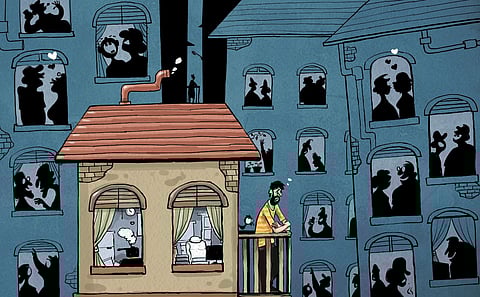
The question, then: “What is the biggest regret of your working life to date as an employee and a human being, in that order?” Surprisingly, the answers were all more or less the same, all pointing to a cluster of thoughts that led one to the narrow alley of loneliness. Loneliness seems to be the biggest corporate disease around. The working person is today more lonely than ever. While some realise it, others don’t.
Everyone, however, is making some kind of effort to fill in this vacuum. The working man and woman are lonely. The younger ones seem more prone to this ‘disease’ than the older ones. The married ones who started a family rather young seem to have escaped, while those still single and looking to form relationships seem to be on a different boat altogether. This is a massive ship of the lonely that’s lurking.
The working young—in the age bracket of 25-35—seem to be working just too hard. There is very little time for them to devote to relationships of any kind. There is the parent at home, the grandparent for some, and then there are friends. Most of these friends are from school and college. New friends at the workplace are really considered a peripheral set of folk with whom they interact, drink, eat, party and work with. As for newer-still friends, there is just no time to make.
The conspiracy deepens. Most working people in the new-age work centres concentrated in cities such as Bengaluru, Chennai, Pune, Hyderabad, Gurugram and the like are migrants. Most leave their hometowns to slap on precious work-experience in the big cities of our tech workplaces. Coincidentally, this is true for spaces such as IT, biotech, retail, gaming, aviation and even more spaces that capture the imagination of the new-age worker.
When you leave Bhubaneswar to work in Bengaluru, you have left your home, your relatives, your friends, your local food and, more importantly, everything that you are most familiar with. You uproot and land in a city where everything is new. Making friends in the new city is possibly the most daunting task at hand. In any case, where do you have the time when all you do is work and party? You work five days a week, sleep an entire day on the weekend to recover, and party again in the evenings to show that you belong to the new city that has gobbled you up.
Time then flies. The days grow into months, and the months into years. The youngster who entered the city has morphed. Work-wise, there is growth and income-wise there is plenty to talk about; but in terms of relationships, there is very little to report. In the bargain, the big city is today filled with working people in their late 20s and early 30s who have no one to call their own in reality.
Yes, some relationships do start at the work-place and do flourish as well, but these are far and few. In most cases, there is so little time to devote to building relationships that a new relationship is itself considered to be a pain and a drain on precious time. The shortcut is therefore adopted—when the physical way just does not work, go virtual.
And there begins a new story. I work with a client in the space of a popular dating app. I have dived deep into data, and find dating apps to have two different avatars. One is the serious-dating type, where the objective is a relationship, and the other is the quest for a one-night stand and a hookup. To those who do not understand these two terms, they just mean the same. A casual sexual fling with no further expectation at all.
The young at our modern workspaces have redefined the very process in which they cater to their needs and wants. The needs and wants are immediate and need to be catered to. The dating app, social mixers of every kind (speed-dating included), and the clubs and pubs of the day are spaces that facilitate a fair bit of these needs and wants. When it comes to desires and aspirations of building long-term relationships, perennial postponement is the norm.
The young in our workspaces are, therefore, lonelier than ever when they wake up on a Monday morning to face a full week of hectic work. They look forward to the weekend and the sleep-and-party routine with equal fervour on a Monday. And therefore in the big city, the bachelor lifestyle is a work-sleep-party routine and a repeat the next week. You never realise when you turned 30 and when that turned 35.
In closing, let me just put a few disparate but telling nuggets of data from the corporate workspaces I have researched: 14 in number over the last 12 months. Some 56 percent of the young are lonely and express it; 23 percent think it but deny; the other 21 percent say they are not lonely. Gender-wise, the women (64 percent) express it more loudly than the men (36 percent). The women are concerned about it more than the men. Also, 4 percent of women and 19 percent men have tried a dating app. And it goes on. I have a lot of data at hand; but the purpose of this piece is not to impress you with the data as much as to bring to the forefront a big issue in the life of the working young today: loneliness.
As the loneliness bug bites more and more, I do believe we are going to come a full circle later than sooner. In the biggest of cities with the most modern workspaces, the new way of getting less lonely is going to be that much-thrashed and trashed institution of marriage. And guess what, the most modern, the most educated, the most liberated and the most prosperous in our cities will embrace an older form of marriage—the arranged marriage. When you can’t make your own relationships happen, your parents just might have to. Touché.
Harish Bijoor | Brand guru & founder of Harish Bijoor Consults Inc
(Views are personal)
(harishbijoor@hotmail.com)