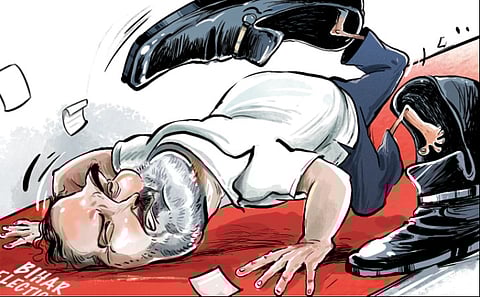

The Bihar assembly result has spawned serious commentary, a slippery gradation of bright-to-dull analyses, and half-serious conspiracy theories. There is little need to revisit them or add a dead layer of another perspective.
However, for someone who viewed the polls from a distance, there was a hazy historical comparison forming at times on the horizon. The comparative picture was also dissolving as swiftly as it was getting formed. Perhaps because it had weak legs of believability, and perhaps it was anathema to put an already-canonised figure next to a struggling revolutionary. But, like a recurring dream and an obsessive thought, it kept persisting through the few months of the poll season. It constantly triggered the question if it can really be the way one is trying to read it, or if it is an embarrassing misread.
As events unfolded, the picture that was throwing itself up was of Rahul Gandhi and Jayaprakash Narayan. The question floating around was if Rahul was trying to be a JP in the build-up to the Bihar polls. Was that the final symbolism and weapon he was trying to unleash against the NDA regime?
JP had created a movement against Rahul’s grandmother Indira Gandhi, and the themes he had worked on then are largely the ones Rahul has been trying to make a success of his utter un-success now. JP, too, had been as fabulously unsuccessful as a political leader—that is, until he had embarked on a revolutionary project in the mid-1970s. JP had walked out of party politics in the 1950s. However, one should hasten to clarify that there is a Himalayan difference between JP and Rahul’s political failures, confusions, and anarchic instincts.
JP had rich academic training and theoretical depth. His ground-level engagement was remarkable. The bouquet of issues he picked up to represent had a stunning range from villages of India to international diplomacy. His stubborn idealism defined the age, and his handsomeness, like that of Rahul, had ripened without an impact. He embraced the wisdom of sacrifice and had an uncommon disdain for holding the levers of power himself. He was self-made, and had no privilege or pedigree to claim.
JP was a grand individual and never, in a manner of speaking, an institution builder, although he was institutionalised by the circumstances of history near the end of his life. Such a failure has greater access to political symbolism than what Rahul can ever aspire to. In short, their backgrounds, pressures, and contexts are at diametrical ends. Therefore, to even think of imitating JP and his method may be anachronistic.
Yet, this season, Rahul picked themes that JP had picked 50 years ago. He tried to tap into the young and tried to dazzle with the accusation of electoral malpractices—‘vote chori’ and ‘Voter Adhikar Yatra’. Rahul, too, has tried to work with students. He spoke about massive unemployment, monumental corruption, and economic backwardness of the majority; so did JP. The Congress, in its official release, claimed that Rahul had made the Modi regime “nervous”. Interestingly, in the mid-1970s, JP too was accused of making the Indira Gandhi regime paranoid.
Between 1971 and 1975, the electoral malpractice charge against Indira Gandhi lingered in the courts and achieved a certain finality in June 1975. This charge had tried to delegitimise her mandate in slow progression, like Rahul has long hoped his persistent campaign would do to Modi. When Raj Narain, who challenged Indira Gandhi’s Rae Bareli election in the courts, went to his lawyer Shanti Bhushan, the first thing he said was about the ‘chemicalised ballots’ she may have used to rig the polls. An air of incredulity hangs in the air even today as Rahul makes his arguments.
JP was accused of instigating the armed forces and the police—the excuse for proclaiming the Emergency. Rahul has similarly been accused of creating doubt around constitutional offices and democratic institutions. During the Bihar campaign, he also shockingly spoke of caste control inside the army, and had earlier spoken about the ‘fraudulent’ Agnipath scheme for the forces.
Themes of vote and voter manipulation in the Bihar poll season aside, there was accusation of a title theft as well. The Congress officially started promoting Rahul as ‘Jan Nayak’. JP was called ‘Lok Nayak’ and, perhaps, an unpaid strategist in the Congress thought a similar-sounding title would deepen Rahul’s revolutionary cause. However, the Congress’s shallow research did not realise that the title of ‘Jan Nayak’ had been given decades ago to backward-class icon Karpoori Thakur.
Before the ‘vote chori’ charge and title-chori talk filled the public square, there was a kind of ideological co-option that Rahul had attempted. Luckily, none of his allies or rivals have so far accused him of a theft of their signature ideas. In the last few years, Rahul has taken to caste identity politics, an original agenda of Mandal politicians. He has taken to federalism, the original cause of the Dravidian parties. He has also appropriated the Left’s economic agenda, and learnt to foreground the Constitution from Ambedkarites. Rahul has tried too many things in a short period of time to rebrand himself, when each of what he has attempted has been a lifetime of commitment for many. There has nothing really been his own.
JP was seen as some kind of an unconventional revolutionary hero. His idea of revolution did not accommodate violence, although he wanted his democracy movement to aim for sampoorna kranti or total revolution. There were many other ideas of revolution at the time that the Marxists, Maoists and Naxalites pursued. But JP, a former Marxist and a socialist, had appropriated the idea of his earlier ideological training to creatively mean Gandhian ‘sarvodaya’ (socio-economic development for all).
The irony of Rahul attempting to be a JP, and the psychological extensions of ‘parakaya pravesha’, or entering another’s body, are inescapable. Arguably, it was JP in the minds of Congressmen who besmirched Indira Gandhi’s place in history. So perhaps Rahul thinks he should be a JP to besmirch Modi. But cloned games are often duds in history. The Bihar result is only the latest proof.
Sugata Srinivasaraju | Senior journalist and author of Strange Burdens: The Politics and Predicaments of Rahul Gandhi
(Views are personal)
(sugatasriraju@gmail.com)