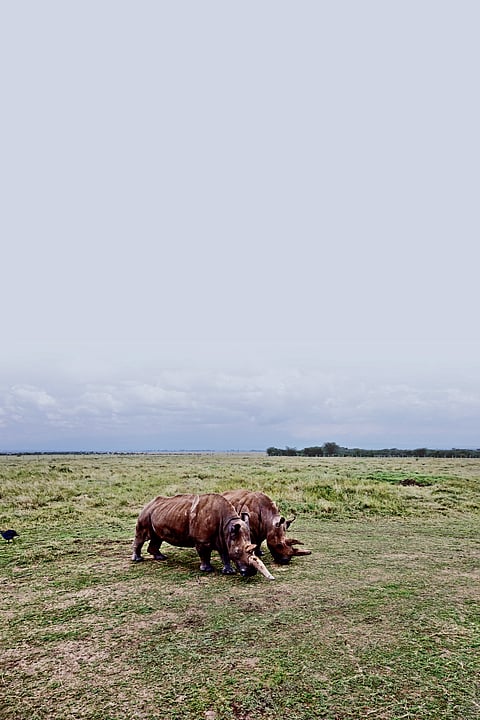

In the sun-drenched grassland of Kenya’s Ol Pejeta Conservancy, two northern white rhinoceros—the last of their kind—graze side-by-side. Visitors stand before this mother-daughter rhino duo in a moment of transcendence, as if they are facing an encounter with the fragility of existence itself. Today, Najin and Fatu, world's last northern white rhino, roam under the constant protection—limited by the fence of the conservancyand the fear of poaching. But their story spans across continents, and their existence is a race against time, hope, and survival.
Though it wasn’t always like that. The rare white rhinos, one of the five species, once roamed freely across Central Africa's grasslands—unaware that humans’ greed for their precious horns would seal their fate in doom. Poaching and civil wars had ravaged their homeland—killing all the wild northern white rhino by early 2000s. In a turn of fate, in 2009, four northern white rhinos made a continental journey from Safari Park Dvur Králové in the Czech republic, to Ol Pejeta; a last-ditch effort to spark natural breeding. But time was not on their side. Suni, one of the two males, died in 2014, while Sudan, the last remaining male, died in 2018, effectively rendering the entire subspecies functionally extinct. The sub-specie’s survival is now pinned to the two last surviving females.
Najin and Fatu, both suffering from severe reproductive pathology, which makes their natural conception impossible. However, there is a silver lining—their ovaries still produce viable eggs. These precious cells, combined with frozen sperm from the deceased males, have yielded 38 northern white rhino embryos—tiny vessels of hope stored in liquid nitrogen across two continents in Berlin and Italy. But uncertainties accompany invention.
The conservancy has become the stage for an unprecedented rescue mission. “If we succeed, in 50 to 70 years, northern whites may once again roam their ancestral lands,” says Zacharia Mutai, the head carer who has been with the rhinos for over three decades. Mutai shares an incredibly moving bond with the girls. He moves lovingly, with compassion, among Najin and Fatu, and their newly introduced southern white companion within the enclosure.
Caring for the last of a sub-species is not an easy task. Mutai bears it for the rest of humanity. Speaking of the research, he says work has recently begun on transferring northern white rhino embryos into surrogate mothers. In late 2023, came a breakthrough with the first-ever rhino pregnancy through IVF (In Vitro Fertilisation), using a southern white rhino embryo as proof of concept. A transfer in December 2024 showed promising signs of early embryo development in the surrogate's uterus, but the it died of an infection.
Parallel efforts in stem cell technology offers hope. Beyond embryo creation, scientists are developing solutions to boost genetic diversity in future founding populations of northern white rhinos. Their ultimate goal? To reintroduce them in the wild.
Until then, beneath the shadow of Mount Kenya, Ol Pejeta Conservancy stands resolute as a last sanctuary for this almost extinct species. Najin and Fatu—two resilient but unknowing participants—protected by armed rangers and solar-powered electric fences, graze side by side, unaware of the weight of an entire subspecies on their broad, ancient shoulders.
Caring for the last of a sub-species is not an easy task. Mutai bears it for the rest of humanity. Speaking of the research, he says work has recently begun on transferring northern white rhino embryos into surrogate mothers. In late 2023, came a breakthrough with the first-ever rhino pregnancy through IVF (In Vitro Fertilisation), using a southern white rhino embryo as proof of concept. A transfer in December 2024 showed promising signs of early embryo development in the surrogate's uterus, but the it died of an infection.
Parallel efforts in stem cell technology offers hope. Beyond embryo creation, scientists are developing solutions to boost genetic diversity in future founding populations of northern white rhinos. Their ultimate goal? To reintroduce them in the wild.
Until then, beneath the shadow of Mount Kenya, Ol Pejeta Conservancy stands resolute as a last sanctuary for this almost extinct species. Najin and Fatu—two resilient but unknowing participants—protected by armed rangers and solar-powered electric fences, graze side by side, unaware of the weight of an entire subspecies on their broad, ancient shoulders.