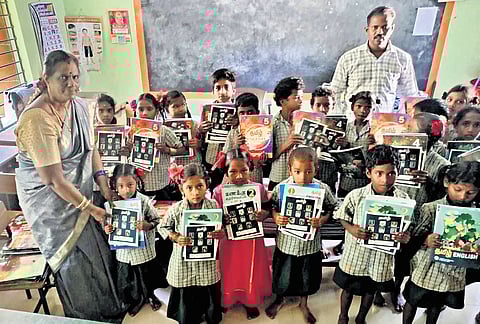

VELLORE: On a chilly December morning in 2014, as the world prepared for Christmas Eve, 46-year-old D Saraswathi guided her scooter over a rugged hillock deep inside the dense Athiyur reserve forest. In Tamil Nadu’s usually sweltering landscape, the temperature had plunged to an unseasonal 18–19°C. In this remote wilderness, where wildlife prowled unseen among the trees, the newly appointed headmistress of Panchayat Union Middle School in Kurumalai, Vellore, paused in confusion — she had lost her way. Her worry turned to alarm when a boy of about ten — Parthiban, casually scratching his neck with the tip of a knife — approached her bluntly, “Nee teacheraa?” (Are you a teacher?) She exhaled in relief, only to discover that he was a grazier who, without much ceremony, pointed her towards the right direction.
That brief exchange — strange, unsettling and oddly grounding — was her first introduction to a place that would reshape her life just as profoundly as she reshaped it.
Today, 11 years later, Saraswathi is proud that she has pushed countless tribal children of Kurumalai to reach their own destinations. The 10-year-old Parthiban, now 21, is preparing for TNPSC’s Group exams, she says with quiet pride. Nestled deep in the folds of the Jawadhu Hills, the Panchayat Union Middle School — functioning only till Class 8 — barely operated when she arrived. Kurumalai lies four kilometres from the foothills and remains cut off from bus services. The rocky forest paths allowed only bikes. At the time, barely four teachers and around 20 of the 70 enrolled students attended school. Saraswathi herself had not imagined landing in such a remote outpost.

As a child, she dreamt of becoming a collector, but with little guidance and an early marriage at 20, she found her path diverted to teaching. Her career began in 1988; by 1996 she was working at a government school near Poigai. After 17 steady years at Abdullapuram, she was promoted in 2010 and posted to a middle school in the Palamathi Hills — an institution she helped upgrade to a high school within five years. And then, in 2014, came the call to Kurumalai. Friends and relatives discouraged her, warning of isolation, wildlife and poor infrastructure.
But Saraswathi had already weathered bigger storms. She chose the hills. From her home in Thorapadi, she rode nearly 15 kilometres every day, climbing 1,820 feet and navigating dirt tracks, hairpin bends, the occasional bear, and venomous snakes. “Earlier, there wasn’t even a proper road. Only in 2022 the bitumen road was laid after several representations,” she recalls. Over the past three years alone, the school’s strength has risen to 92 students, with full attendance slowly becoming the norm and dropout rates dropping sharply.
Kurumalai, home to the Malayali tribal community, follows a rhythm shaped by tradition. Festival weeks often kept children away from school. Saraswathi did not force change; she nudged it. Walking hamlet to hamlet, she met parents where they were — on fields, at doorsteps, sometimes on forest trails. “I tell parents how important education is,” she says.
“If they send their children today, they won’t have to struggle like we did. Even basic learning can help them get small jobs or start something of their own.” Her efforts have also reshaped the lives of young girls. Child marriage, once common in these hamlets, has declined as education opened new possibilities. Saraswathi proudly speaks of Radhika, a final- year BSc Zoology student poised to become Kurumalai’s first graduate. For parents, her commitment became impossible to ignore. “When ma’am comes this far and takes classes to improve our lives, how can we not send our children?” asks R Madhavi, a resident. Even after earning the community’s trust, Saraswathi’s concerns remain practical and urgent. She is relentlessly pursuing broadband access for the school, pushing telecom providers to install a tower. “Right now, we walk nearly a kilometre just to catch a signal to mark attendance or complete online work,” she says. She also dreams of securing government support to provide bikes so students need not walk three steep kilometres every day. As JD Salinger once wrote, “You can’t stop a teacher when they want to do something. They just do it.” Saraswathi proved him exactly right. Bearing the name of Saraswati, the Hindu goddess of learning, she became an unquenchable flame — small, stubborn, defiant — lighting not only classrooms but entire futures.
(Edited by Swarnali Dutta)