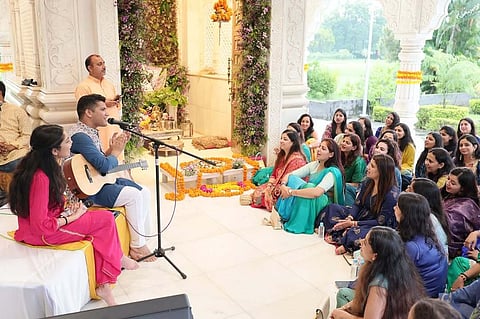

A new trend is reportedly rocking young India called ‘bhajan clubbing’, in which Gen Z gathers in various spaces for sessions of singing and dancing to remixed devotional songs. Chai and buttermilk are to hand, not the liquor served in Western-style pubs and clubs. There are diyas, candles, incense sticks, and flowers to create a pleasant atmosphere. The young dress up, or don’t, depending on the occasion, clap along, and sing to guitars and drums. The music is modern, but the words are old, including mahamantras like ‘Hare Rama, Hare Rama’.
If we look, we’ll see that this movement was growing organically, with important contributions to the ‘vibe’ from singers like Shankar Mahadevan, Kailash Kher, Jubin Nautiyal, and a score more. The happy-clappy satsang and naamkirtan culture already in place was made more modern. The electric atmosphere during festivals like Navratri, Mahashivratri, and Janmashtami at temples, garba grounds, and in popular ashrams also fostered this development. Purists may cavil, but doesn’t it sound perfectly natural for a singing, dancing nation? The young have found their own, blessedly free expression of belief, blending fun and faith.
I welcome this trend with all my heart and wish it had happened in my youth. It would have been grounding, energising, and expressive of the Ananda or joy, which is the driving principle of this upbeat faith. I would not have been conditioned to be a ‘coconut’—brown outside and white inside. I mourn that I belong to the cheated urban generation that was denied Sanskrit. I was taught French instead. No learning is wasted, true, but our access to and understanding of our heritage should not have been removed either. I am very thankful that the two terrible fault lines in our culture—caste and gender—are being repaired. I regret that along the way, they ‘threw the baby out with the bathwater’.
This brings back a question I was pointedly asked when I began writing about religion over twenty-five years ago, thanks to the newspaper editors who took a wild chance on me. Prior to that, growing up had been complicated. My mother, the believer, was long dead, my father was basically irreligious, and I was swamped by proud atheists. They were decent people, bright and well-spoken, whose one blind spot was faith. My friends included the ‘Khan Market gang’ and ‘Lutyens gang’ that ridiculed Indian religion. I was taken aback by the underlying self-hate when people breezily said things like, “Ram was a wimp”. My authentic self—a low-maintenance Hindu, maybe, but a Hindu nevertheless—was hidden from them. My faith became “the love that dare not speak its name”.
But my cover was blown when I began writing about religion. I couldn’t lie there, though I openly shared my doubts, queries, and critiques, drawing flak from traditionalists. All hell broke loose in my little world when I tried to explain the Hindu’s visceral need for temples, headlined ‘A House for Mr Vishwas’. ‘Left-lib’ friends told me sternly, “Renuka, you’ve become embarrassing,” and scornfully demanded, “What’s a column on religion doing in a newspaper?”
Wait, my peer group found me ridiculous, and was pressuring me to stop? It was a stark moment of choice. I chose God. A response came to me. “I think a newspaper could be compared to a farm,” I said slowly. “The news pages bear staple crops like wheat and rice. The sports and feature pages grow spice and vegetable crops. The business pages are the mandi, the crop market. The editorial pages are orchards, with the fruit of thought.”
“So, what’s a faith column?” my friends repeated. Their tone had subtly shifted, as though processing the comparison. An answer lit up in my head. “A faith column is the kesar bagh,” I said. “The ‘saffron garden’, as a garden of precious herbs is called. Its space may be smaller than that of the big crops. But if honestly tended, perhaps its scent may be able to enhance the quality of life.” There was a long moment of silence, and I looked back steadily, for, in having to explain myself, I found I had clarified my own thoughts. Perhaps it was what we’d call “the Upanishadic reflex”—to respond with a plausible analogy. I wondered if, unrecognised by both parties, this pattern was so culturally entrenched over the millennia that even Macaulay could not fully uproot it. For they accepted the analogy, though they stuck to their disregard for faith.
We continued as friends, with the uncomfortable understanding that I walked a different path. I heard them tell others that I was “not really like that”. Once, when I showed up for lunch at the Delhi Gymkhana Club with a tilak on my forehead because I’d stopped by the Yogmaya temple, my smart friends were horrified and icily asked why I’d turned into a sadhvi. By then, I’d grown past explaining and merely raised a ‘So, sue me’ eyebrow. Then one of them said, “She’s not a sadhvi,” and the moment passed.
I’d thought about life without the approval of the people I knew. It was fine, I’d realised, with growing excitement, for I was on a valid, if lone, personal journey in dialogue with the public. I had somehow arrived, stumbling, at the golden shore of a vast ocean, a fathomless treasure trove. It’s me, the almost-outcast, who loves how Gen Z is making faith its own, combining music, devotion, and community. Sing and dance, dear people. Hari bol, with rightful joy.
Renuka Narayanan | FAITHLINE | Senior journalist
(Views are personal)
(shebaba09@gmail.com)