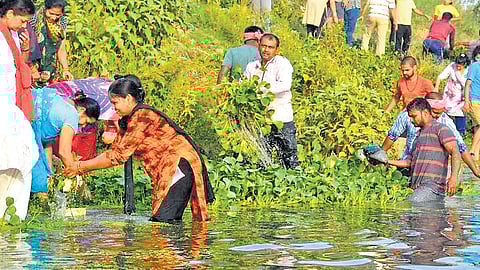

UTTAR PRADESH : For people in Azamgarh, the Tamsa was never just a stretch of flowing water. It was something handed down across generations, familiar in prayers, in old family tales, and in the way elders spoke about the land. That is why its slow deterioration felt like more than an environmental problem. As the river sunk into deterioration, many felt as if a part of their own past was slipping away from them.
Ravindra Kumar, District Magistrate of Azamgarh, remembers sensing that loss most acutely while standing at a stretch near Chandreshwar Dham last year. Reviving the river would mean reviving a part of Azamgarh’s soul, he would say. With that conviction, he launched what began as an administrative initiative and soon turned into a full-fledged public movement.
It is the river beside which Sage Valmiki offered refuge to Sita, where Lava and Kusha were born, and where the sage, moved by the sorrow of a bird, composed the first shloka of the Ramayana. In July 2025, he launched a month-long rejuvenation ive starting at Chandreshwar Dham. The plan brought together the State Mission for Clean Ganga and district-level committees.
Soon, villagers arrived with tools, pradhans rallied groups of young volunteers, and local civil societies stepped in to coordinate the work. The 264-km river—89 km of it in Azamgarh—had suddenly become a shared responsibility. “The moment the community stepped in, it stopped being an official project,” Kumar said.
Beyond cleaning, the campaign also focused on restoring infrastructure at religious and historical sites.
The results arrived faster than expected. Water clarity improved; small fish returned. On June 21, 2025, the rejuvenated ghats hosted International Yoga Day—an image that captured both ecological revival and cultural renewal. Praise has come from the state government, including Chief Minister Yogi Adityanath.