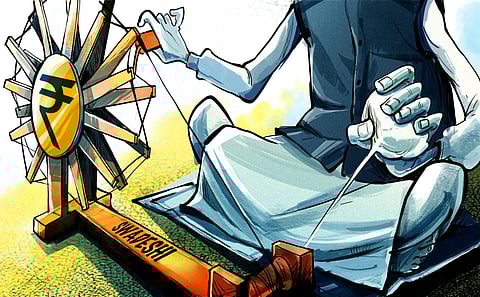

This essay is an attempt to explore the relation between the word and the world in the domain of policy. One must confess the domain of policy has become an esoteric world—full of arcane interpretations of ordinary language.
The recent exchange of words between Donald Trump and Narendra Modi escalated a lot in the news. It has been seen as a battle between two nations on tariffs and trade. It is also a struggle for dignity. Modi has raised the word ‘swadeshi’ in this context. One hopes to explore the fate of this word.
Modi’s use of the word is strictly economic; but one has to locate this sense of swadeshi within a wider historical and philosophical context. The most fruitful way of doing this is to contrast Modi’s construct of swadeshi with a Gandhian imagination.
One has to, first of all, emphasise that while Modi exudes the official, Mahatma Gandhi’s is a playful performance. Gandhi displayed a cultural confidence against the British. One can see the power of his attitude in two small anecdotes. Once an American journalist asked Gandhi what he thought of Western civilisation. He replied, ‘It would be a good idea.’ Gandhi went further. He said the task of the Indian national movement was not just to overthrow the British, but to rescue them from the travails of modernity.
To the cultural confidence that underlay swadeshi and swaraj to its playfulness, one must add a polysemic power. For Gandhi, these two words conveyed a spectrum of meanings. Swadeshi implied the indigenous, the local, and the vernacular. Each summoned a different domain of meaning. Each mapped a different angle to life. The word that immediately comes to mind is ‘local’. It implied a geography, a sense of neighbourhood. Swadeshi implied that the local was primary.
But Gandhi used the word local in a slightly different sense. The local was also indigenous. It implied not only geography, but also a sense of cultural time. The local was an attempt to sustain diversity and plurality, not just uniformity. The local implied not just economics, but a sense of linguistics and materials. The local implied local materials, local seeds, a local imagination. Each microcosm added to the richness of the macrocosm we call swaraj.
Swaraj, in that sense, is a more holistic term. Yet the two words are connected. Each connects a word and a world. Modi’s sense of swadeshi is too shortsighted to capture this cultural imagination. Swadeshi in the sense implies trusteeship, a sense of caring, not just a parochial sense of security. The relation between language, culture, technology, and economics is just manifold.
Swadeshi and swaraj are not just questions of scale; they imply a relation of parts to a whole—microcosm to macrocosm. The Gandhian activist Ela Bhatt put it brilliantly. She said swadeshi and swaraj are ‘home science’ words. You use the metaphor of the home not just to create a local space, but a home in the world. Domesticity and international relations weave together, so in a sense a concern for a dewdrop is a sense of the ocean.
Gandhi’s sense of swaraj was playful and holistic. Modi’s sense of swaraj is a purely official, narrow, arid idea of the nation’s state. It suffers from a rigor mortis of the imagination. If Modi had a sense of swaraj today, he would have challenged Israelis’ actions on the Gaza Strip. Instead of letting Palestinians starve, Modi would have flooded the area with langars, turning food into a gift of peace. His silence, his international relations, has no sense of swaraj.
Modi also lacks a genuine sense of swadeshi. Swadeshi as an idea doesn’t try to exclude, it seeks to encompass. The local always signals the hospitable. Gandhi’s sense of swadeshi and swaraj in that sense was hospitable, deeply caring, sensitive to culture—it embodied a trusteeship of diversity on every front. Modi is all for modernity. He is seeking to change the Andamans through development projects; Gandhi would have built a satyagraha around the project and would do something similar with Manipur. What we notice, thus, is that Modi’s concept of swadeshi is an added political concept, with little sense of generosity.
Swadeshi and swaraj would have shown that Trump’s idea of culture and democracy is empty. An advocate of swadeshi would have opened out to the Mexican migrant and the Palestinian refugee. Swadeshi and swaraj enrich the concept of citizenship and does not subject it to the arid policy of security turning citizenship into the most impoverished forms of being. A citizenship without swadeshi and swaraj is empty.
One must emphasise that the relationship between the word and the world is critical for democracy. The power of concepts reveals the creativity of democracy. Democracy, in that sense, always shows a linguistic richness; not the linguistic regimentation the current central policymakers subject concepts to. This raises fundamental problems for the democratic imagination. It eliminates nationalism over democracy and, thus, impoverishes the linguistic power of democracy. The poetics of the word sustains the poetics of democracy. It is today’s aridity of concepts in India that becomes disconcerting for the future.
It’s the absence of swaraj as an imagination that makes the current leadership deaf to the Anthropocene as an idea, as an image of a damaged world. Earth today has been damaged by man— it’s geologically so devastated that man’s destruction of the world has become a geological age in itself. Today’s sense of Indian nationalism blinds the nation to the future of Earth as an ecology.
This raises problems for civil society. Scientist C V Seshadri suggested that civil society must comprise a ‘don’t use me’ dictionary. This should comprise a bracketing of words like security, development, boundary, patriotism—words which desiccate, words which lack the power and creativity of non-violence. Swadeshi and swaraj were indicators of non-violence. They sought to expose a violence that was not a word.
Civil society must use linguistics as a lens for understanding dangers to its life-word. This is the challenge before the reader today—he must question policy at the linguistic, ethical and aesthetic levels. Without such a sense of trusteeship, swadeshi and swaraj cannot survive. This is a challenge before Indian democracy today.
Shiv Visvanathan | Social scientist associated with the Compost Heap, a group researching alternative imaginations
(Views are personal)
(svcsds@gmail.com)