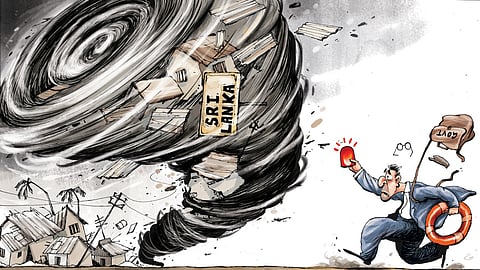

On November 28, Sundaram Thevapalan (36) and his family had to wade through Colombo’s flood waters to find shelter. They received no alerts of 200 mm of rainfall or flooding. The rising water itself served as a warning for those in Colombo’s low-lying areas. There were no temple bells, government announcements, or community-based messages. “You read the crisis when water reached your doorstep,” he said.
As torrential rains lashed out, Cyclone Ditwah, the worst cyclone to hit the Indian Ocean island nation since 2003, left a trail of destruction. There were 334 deaths, 147,931 displaced, and 370 reported missing.
In the past 130 years, the island faced 16 cyclones, five of them severe, including those in 1978, 2000 and 2003. According to the 2024 Risk Information Index, 87 percent of the population is at medium or high climate risk. Between 2015 and 2022, 304 climate-related disasters were recorded, compared to 35 between 2008 and 2014. This calls for an effective, multi-pronged disaster response that activates upon early warnings.
While the country was overwhelmed by rescue demands, mounting public frustration focused on the state response, from a lack of a combined relief-and-rescue mechanism to failures to declare a national emergency and communicate in a timely manner.
If a November 12 warning by Athula Karunanayake, Director General of the Department of Meteorology, had been heeded, the nation could have been better prepared. In a television discussion, Karunanayake strongly predicted that a depression would develop in the Bay of Bengal by November 14, with the possibility of severe weather.
Having lived through severe storms and the 2004 tsunami, Sri Lanka still seems not to have got its act together. Despite the magnitude of this disaster, the response was slow, poorly coordinated, and insensitive to language. As bad weather intensified, a public holiday was declared on November 28. This affected emergency communications as people reached out to local authorities, only to find no one available. President Dissanayake declared a national emergency on November 29 amid growing criticism of the state’s failure to mount an effective, coordinated response to the disaster. Making matters worse, public communications were issued mostly in Sinhala, in violation of the country’s language policy and denying critical information to the Tamil-speaking public.
Due to a weak response, the government is now criticised for adding to Cyclone Ditwah’s trail of destruction, through omissions that could have contributed to increased fatalities. The majority of disaster warnings being issued only in Sinhala are not a communication error: they are a governance disaster steeped in language discrimination that denied life-saving information at a critical time. The Tamil Guardian first claimed that despite the severity of the cyclone, people in the island’s cyclone-battered North and East could not use the information as the state continuously issued almost all emergency communications exclusively in Sinhala or English. “Even official warnings shared by ministries and the DMC at a press conference held at the defence ministry were issued without translation, with Tamil completely excluded and only occasional updates available in English,” the Tamil Guardian claimed.
Sanjana Hattotuwa, a Colombo-based disinformation expert and analyst, studied 68 posts on the Disaster Management Centre’s official Facebook page posted from November 25 to 7.15 am on November 29. In a LinkedIn post, he noted all critical information on the banner page was in Sinhala. “Of the 68 Facebook posts, just a dozen featured content and vital updates in Tamil. When machine translation was used to study the updates, all of them were related to flooding or the high risk of flooding,” he stated.
Hattotuwa further noted: “There was a significant disparity in both the frequency and the granularity of lifesaving, critical information provided in Sinhala versus Tamil. While Sinhala DMC Facebook updates covered a wide spectrum of disaster management, including specific road closures and Advanced Level exam logistics, the posts/updates in Tamil were exclusively around flooding.”
Accordingly, what was not effectively communicated to the Tamil-speaking public included, landslide warnings (not a single post in Tamil detailing specific landslide risks despite Tamils living in the hill country, a demographic most vulnerable to landslides), information on critical infrastructure and road closure updates, education and logistical updates such as postponement of examinations, specific river basin-related warnings, granularity of maritime and wind warnings. “The DMC’s official website has a selection for Tamil, but aside from page navigation, header, and footer text, everything else remains in Sinhala (or English). By November 28, I had studied 85 updates posted on the Meteorology Department’s website.” He also studied the official Facebook page, which featured 36 posts in Tamil.
Despite improved language use, Hattotuwa observed significant delays in communicating urgent, life-threatening hazards, poor communication of threat levels from hazard to risk escalation, and inconsistent forecasts. A case in point is the detailed and consistent Sinhala morning forecasts for coastal areas and fishing activities, which went missing in the Tamil posts.
This begs the question about the state’s language practice as much as its own disaster preparedness. Critical institutions such as the Disaster Management Centre (DMC) should be the one-stop source for the timely sharing of critical information.
When Cyclone Ditwah is eventually added to the island’s cyclone history, moving forward, strengthening disaster communications should be prioritised as part of Sri Lanka’s disaster resilience needs. It calls for multilingual capacity, disaster readiness, a combined mechanism/response, and much more.
Once the floods recede and a semblance of normalcy returns, Sri Lanka should also ask some hard questions on state accountability. It is well worth an inquiry to know why the nation did not start preparing from November 12 itself and be response-ready, and why the declaration of a national emergency was an afterthought. Sri Lanka must snap out of being an ambulance chaser all the time and be an early warning system to its nearly 22 million people.
Dilrukshi Handunnetti | Award-winning journalist and lawyer; founder and director of the Colombo-based Center for Investigative Reporting
(Views are personal)
(dilrukshi@cir.lk)