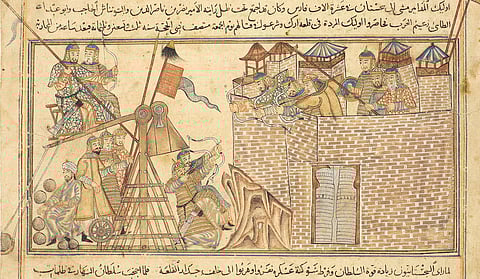

The Mongols are believed to have used the first bioweapon in recorded history in 1346, when the forces of the Golden Horde under Khan Jani Beg catapulted a corpse infected by bubonic plague into the besieged Genoese citadel of Caffa in the Crimea. Caffa, now called Feodosia, has been an important port for centuries. It controlled the medieval Black Sea trade, including the eternally lucrative business of slavery, and was a terminus of the Silk Route. It is still strategically important—nominally Ukrainian, but administered by Russia. After the Russian invasion began, the world took note when Ukrainian aircraft attacked Russian warship Novocherkassk in the Feodosia harbour.
In 1346, the unknown soldier who served as a bioweapon decisively ended the siege of Caffa. The Genoese fled to Italy, carrying the plague with them into Europe, which it ravaged for the next four years, changing the course of history. For about 50 years, this one-man story has explained the rapid spread of the plague east to west across the Old World, from China to Iberia and the British isles. There’s even a name for it: the quick transit theory. When the Covid-19 outbreak was traced to Wuhan, the story of Caffa was recalled, and it was suggested that deadly epidemics inevitably originate in China and travel west at top speed. Covid moved very fast because of air travel, but were earlier pandemics so fast-moving?
A paper in the October 31 edition of the Journal of Arabic and Islamic Studies challenges the theory. In this edition focused on environmental challenges that shaped history in West Asia and Europe, authors Muhammed Omar and Nahyan Fancy of the University of Exeter argue that ‘quick transit’ is based on a misreading of creative writing as factual history. Their paper, ‘Mamluk Maqamas on the Black Death’, says that the theory rests on the work of American academic Michael Dols, a pioneer in the study of pandemics in history. He had relied on the Risalah al-naba an al-waba (1348-49) of the scholar Ibn al-Wardi, which described the arrival of the plague in West Asia like a tsunami coming down the Silk Road, destroying cultures in its path.
But the Islamic tradition differentiates clearly between history (tabaqat or tarikh) and cultural products like maqamas, the genre to which the Risalat belongs. Maqamas were picaresque accounts of ‘trickster’ figures, a feature in almost all the world’s mythologies—Loki being the best-known among them, thanks to American popular culture. In the Risalat, the trickster is the disease itself. A modern equivalent could be the story of Indian migrants walking home during the pandemic, which is essentially Neeraj Ghaywan’s Homebound, based on Basharat Peer’s New York Times newsfeature ‘Taking Amrit Home’. It expresses the helplessness of mere mortals in the face of a global catastrophe, but future generations should not mistake it for formal history. Similarly, the Risalat expressed the feelings of people facing the imponderable. We, the future generations in this case, can read it for signs of what the plague did to the psyche of societies it overran. But we should not regard it as a factual account of the progress of the pandemic.
The importance of the distinction would be obvious if we return to the story of the allegedly rapid transit of bubonic plague from a reservoir in China to Europe via a Crimean conflict. A story which begins with a disease-ridden corpse being catapulted into a fortress cannot but be compelling. But people have long suspected that history is not so tightly scripted. It tends to be slow and messy.
There is, for instance, the question of the Justinian plagues that swept Europe from 541 CE, eight centuries before the Black Death, and recurred repeatedly across the Mediterranean, North Africa, Italy, Gaul, and West Asia until the 8th century. These plagues killed up to 50 million and contributed to the end of the Pax Romana—fortunately, not before the Laws of Justinian had established the basic principles of Western civil jurisprudence, which spread across the world during the colonial era and now underlie most legal systems. The Black Death persisted until the 18th century in Ukraine and Russia. Over a century later, in 1855, another plague spread by ship from Yunnan to Hong Kong (1894), Bombay (1896), and California (1900). Even now, at least one plague death is reported from the US every year.
So, decades after the Black Death was attributed to a Mongol bioweapon, that simple and compelling story stands challenged by information that was always on the historical record. And, as we can see from the dates in the last outbreak, the contagion took years to spread. The idea that pandemics were transmitted like a speeding arrow across the world was incorrect—until air travel gave wings to Covid.
Apart from the implicit importance of consulting all sources in historical analysis, Muhammed Omar and Nahyan Fancy’s paper urges the need to distinguish between fact and fiction, which eternally compete to tell our stories. It’s a timely reminder, when careless readers of the most enduring bestsellers have become prone to discovering ectopic shivlings in mosques, gold in Sonbhadra, idols in the tahkhana of the Taj Mahal, a causeway to Sri Lanka, the authenticity of the Manusmriti and arks, tabernacles, and chariots of the gods everywhere—from Mount Ararat to Hollywood.
Pratik Kanjilal | SPEAKEASY | Senior Fellow, Henry J Leir Institute of Migration and Human Security, Fletcher School, Tufts University
(Views are personal)
(Tweets @pratik_k)