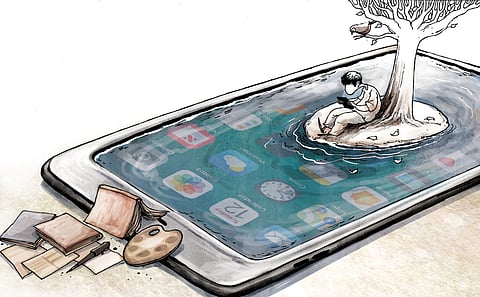

Think this out. What are you addicted to? What’s your addiction? What’s your daily fix? All of us have one. It could be your morning newspaper read. It could be your morning cup of filter coffee. Or both. But each one of us has one, if not many.
Addiction, then, is the disease I am writing about. I call it one as it seems to be quite an epidemic as of now. It’s all around us. It is within us. And yet we don’t recognise it to be what it is. We continue oblivious, leading ostensibly happy lives.
Without pointing fingers out at the society all around us, let me talk of my personal addictions. I am addicted to my morning cup of coffee accompanied by my favorite newspaper every morning. If it’s a holiday for the newspaper, my coffee doesn’t taste half as good. And vice versa. I am addicted to the habit of posting on X, Threads, Instagram, and LinkedIn first thing every morning. I need to do it every day. I am addicted to chocolate just as I am addicted to rice. A meal without rice is no meal to eat at all.
You have your addictions and I have mine. Some are addicted to cigarettes, some to alcohol, and some to endlessly flipping fingers on Instagram reels. All are addictions for sure. Some happened on their own by habit, and others got planted there by purpose. Either way, over a period of time, each one of us has a bundle of addictions which we have either bought into on our own or have been subliminally forced to own by someone out there profiting from the addiction business altogether. Whatever it is, there seem to be very few people around who can claim they are addiction-free. If you are one of them, I doff my ‘Mysuru peta’ to you.
I have just closed a study on the addictions of the young in India. The definition of this swathe of ‘young’ lies in the age-group of 10-35 in India. We did this probe across 13 big urban agglomerations and 106 villages in India. We had a sample size that is representative across the regions and the data-peek I present at the macro level here is as fresh as three weeks new. Let me just cover the top-line finding. The big headline.
The young in India are bored. Despite being engaged in a frenetic lifecycle of study, work, and play, the young are bored. They are typically bored of whatever they do. If you are studying, you are bored of studying. If you are teaching, you are bored of teaching. This boredom index varies across age groups and regions, but by and large, everyone is bored and wants to do something different. Something apart from what they are doing.
In the old days, the hobby was an escape mechanism. Today, the hobbies of yore have died. Stamp-collecting went away with the literal death of the traditional postal system itself. Pen-friendship (a hobby where you made friends with people you never met through the exchange of letters) died with it as well. The birds are still around, but who wants to be a bird-watcher? Bee-keeping is a clumsy thing to do.
The young in India today are sublimating every differentiated hobby of the past into the common hobbies of the day forced upon them by the digital revolution that has overtaken our lives. All of a sudden, the advent of television in the country itself brought in the prime addiction of watching short and long format programs on television. This killed the hobby of going to the movies in theatres and transitioned it to a swathe of stuff you can watch on television today in the privacy of your drawing room.
Digital media today has killed every hobby there is. Whatever your old hobby was, it can be done virtually online. You can travel to distant places online, meet new people on dating sites, and can listen to music digitally with ease today. Every hobby has got reduced to something you can do with ease with the digital ally.
The old hobbies have given way to new addictions. While hobbies were a benign pleasure, the new addiction that dominates the young in India today is a bit worrying on the score of many being negative in terms of encouraging sloth, repetitiveness and the inane habit. Many of these new addictions of the day seem to add very little value to the life of the person who is addicted as opposed to the marketer of the alleged addiction.
Is addiction marketed today then? I do believe it is. Every marketer, in more ways than one, loves his potential customer to stay hooked to his offering. In a bid to achieve this prime objective, the marketer is quick to put together a programme that makes a customer habituated first and addicted next to what is on offer.
There is the physical addiction and the mental. While the physical bodily addiction could be pinpointed to categories such as smoking and alcohol consumption, the other type of addiction is the one built consciously by brands. Every brand wants customers to first try, then get habituated in stage one, and eventually get addicted to the brand and its myriad subliminal offerings of joy and satiation.
To that extent, a brand of tea is just as guilty of this craving creation as is a quick service restaurant brand that offers a global brand of coffee at its many cafés. The idea is simple. First, make it a habit and then convert it into an addiction. By this standard, do you feel addicted to anything around you? Something you can’t do without in a single day? Please don’t say no too quickly. Do think it out.
Every young person we met to study new addictions said they are not addicted. No one admits that they are addicted, never mind the fact they spend 82 minutes on Instagram, 41 on Facebook, and 3 minutes on X in a single day. It seems clear that as more and more repetitive work they used to do in the past go to machines, more and more of our young are diverting that free time from repetitive work to repetitive play.
Time on hand is now diverted to digital addictions that bring comfort in their repetitiveness. Scrolling on Instagram and swiping left and right on dating sites are but just two addictions. Being on the phone in a conversation is another. Being on WhatsApp is yet another. Addictions that are making us rather repetitive beings on a digital treadmill that just never stops.
Think. Someone out there is gaining. And lots of us are losing. And none of us wants to admit that we are addicted. The truth then: an addict never knows. Not till it’s too late. Is it late already?
Harish Bijoor | Brand guru & founder of Harish Bijoor Consults Inc
(Views are personal)
(harishbijoor@hotmail.com)