
BHUBANESWAR: In a first in the country, the Odisha government has developed a comprehensive policy framework in the form of a ‘declaration’ to recognise women farmers as architects of resilience, guardians of living heritage and champions of sustainable agriculture.
The ‘Bhubaneswar Declaration on Women Farmers and Conservation of Agricultural Heritage’ (accessed by TNIE) will act as a blueprint for gender transformation, biodiversity revival and restoration of agricultural heritage in the state at a time when the United Nations is celebrating 2026 as the International Year of the Woman Farmer (IYWF).
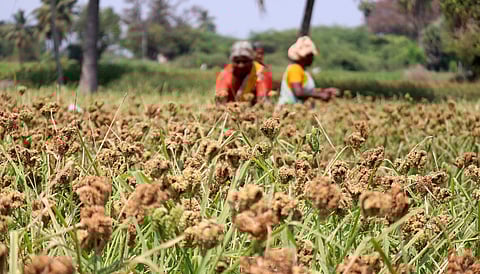
Women play a central role in agrifood systems in Odisha as the fairer sex constitutes around 54 per cent of the agricultural workforce. They contribute to all stages of value chains, whether it is preserving seeds, cultivating crops, processing, or trade. However, their contributions often go unrecognised and barely 13 per cent of farmland owners are women.
he state's rich cultural diversity is blended with its diverse food systems and women stand at the heart of these biodiverse ecosystems, balancing farming with seed conservation, foraging and ecological restoration. But despite the extensive involvement, their contributions often go unrecognised and barely 13 per cent of farmland owners are women.
The declaration formulated by the Agriculture and Farmers’ Empowerment (A&FE) department has outlined several major areas of action, including access and control over resources, agro-biodiversity conservation, agricultural heritage restoration, health and nutrition, agricultural mechanisation, research and innovation, value chain advancement, extension and capacity-building and awareness generation, besides the policy coherence.
It has stressed the need to enhance women’s access and control over resources by encouraging families to register land in the name of women, ensuring joint or independent ownership and addressing the specific needs of single women farmers. It emphasises the importance of supporting women with Forest Rights Act titles and enabling them to access relevant agricultural schemes.
Recognising the challenges faced by women-led cooperatives and Farmer Producer Organisations (FPOs), the government has committed to provide at least five years of technical and financial handholding to strengthen their capacity and support improved access to grants, microfinance and low-collateral credit facilities to promote women’s economic empowerment.
A substantial part of the declaration focuses on agrobiodiversity conservation, calling for the identification and promotion of indigenous technical knowledge related to seed selection, cropping systems, traditional food processing and nutritional profiling of landraces. It also aims to promote neglected and underutilised crops, backed by targeted subsidies, legal protection and transparent benefit-sharing mechanisms for women custodians of biodiversity.
“Heritage conservation will find a place in school-level curricula and biodiversity registers will be developed in collaboration with national and state biodiversity authorities. Scientific research on the cultivation practices, cropping systems and bio-inputs related to landraces and traditional varieties will be supported to improve income and nutritional outcomes with special focus on gender and agrobiodiversity,” read the declaration.
Women-centric agricultural mechanisation is another key component as the state plans to prioritise the development and ergonomic testing of tools and machinery suited to women’s needs. It also encourages women’s representation by at least 33 per cent in agriculture boards, cooperatives, user associations and relevant departments to promote inclusive decision-making.
Principal secretary of A&FE Arabinda Padhee said, “The declaration unveiled for the first time in India suggests the inclusivity of women farmers in the agricultural development agenda. It has been shared with different national and international organisations and institutions. Rest of India can now follow the Odisha model.”