
ROURKELA: An all-women team of researchers at the National Institute of Technology-Rourkela (NIT-R) has designed an innovative system for making highly-contaminated wastewater reusable, with a target to revitalise India’s dhobi ghats and protect urban water bodies.
The nature-inspired, low-cost, chemical-free and energy-independent wastewater treatment model works by merging wetland plants, engineered filtration layers and electricity producing microorganisms.
The team led by associate professor in department of Biotechnology and Medical Engineering Kasturi Dutta along with researchers Divyani Kumari and Karthika Shanmugam has developed it as ‘Constructed Wetland-Microbial Fuel Cell (CW-MFC) System’ to specifically treat highly-polluted laundry wastewater.
The researchers said the positive environmental impacts of the model go far beyond than barely making wastewater reusable. Dhobi ghats, the traditional laundry spaces, still serve as socio-economic support in many Indian cities. Intense pressure on surface and ground water leading to scarcity is a stark reality. On top of it, untreated laundry wastewater, laden with synthetic detergents, dyes and microfibres, contaminates rivers, lakes and wetlands to exacerbate water scarcity and harm aquatic ecosystems.
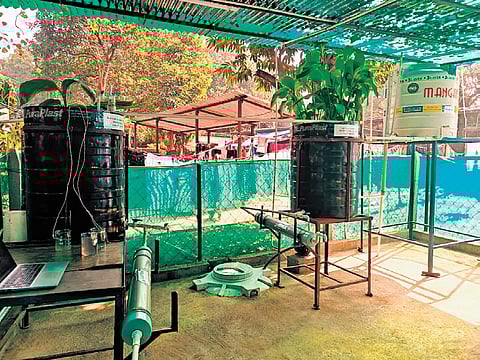
As a pilot project, the system was tested at NIT-R’s own dhobi ghat which produces approximately 1,400 litre of detergent-filled wastewater daily. The system successfully removed surfactants and chemical oxygen demand (COD) to levels of permissible limits (1 ppm) specified by the Bureau of Indian Standards.
The model consists of two cylindrical constructed wetland units integrated with a microbial fuel cell. Each unit is filled with layers of differently-sized gravel, followed by sand and soil. A layer of graphite chunks is placed at the bottom between the gravel layers to function as the anode, while another layer of graphite chunks at the top serves as the cathode. Both units are planted with the locally available wetland species plant scientifically named ‘Canna spp.’
The wastewater from dhobi ghat is pumped up to an overhead tank which is connected to the system. The wastewater then gets processed and treated to come out as odourless and colourless for reuse for washing purposes.
Dutta said, “The wastewater treatment system developed by our team uses gravel, sand, soil, plants, and microbes. It is inspired by nature and engineered for clean water. By leveraging the natural purification processes and generating bioelectricity in treatment state, the system opens way for decentralised wastewater management. Being low-cost with minimal maintenance makes it highly adaptable for deployment in urban slums, peri-urban settlements and rural laundry setup.”
Being capable of generating real-time bioelectricity, the system can treat unlimited wastewater. Treatment capacity can be increased with increase in size of the system which may cater to densely-populated dhobi ghats.