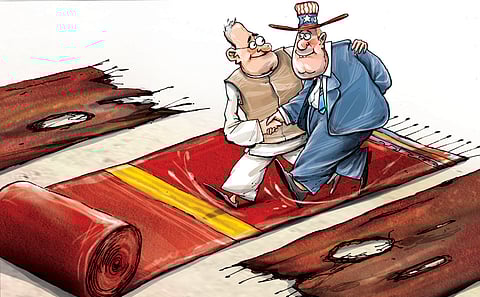

In a world increasingly defined by fragmentation and flux, the relationship between India and the US remains one of the few partnerships with the potential to shape a more stable, democratic, and innovative global order. The recent confirmation of a new US ambassador to India—a close aide of Donald Trump, albeit with no prior diplomatic or India experience, Sergio Gor—signals Washington’s intent to reinvigorate ties with New Delhi at a time when both countries face shared challenges and converging opportunities.
President Trump’s recent remarks about Prime Minister Narendra Modi, calling him “a strong leader and a great friend”, mark a notable shift in tone from earlier weeks of undiplomatic statements and social media posts. While recent frictions over tariffs and trade imbalances have strained the relationship, the current moment appears to offer a chance to reset. Encouraging signs point to the possibility of a new bilateral trade deal, which could unlock growth, investment, and innovation across sectors ranging from pharmaceuticals and semiconductors to clean energy and artificial intelligence.
But to seize this moment, both sides must confront and clarify the geopolitical realities that shape their choices. At one time, both Washington and New Delhi saw the spectre of Chinese assertiveness looming large—from the Himalayas to South China Sea, from cyber intrusions to supply chain dependencies—and made common cause in recognising the need to constrain it. But after the recent ‘G2 Summit’ in Busan, there is renewed confusion about whether the US still sees China as a strategic competitor and global rival, or whether we are witnessing the dawning of a co-operative condominium arrangement between the two great powers of our times.
For India, the challenge is existential: we must defend our sovereignty while accelerating our development. Washington must decide whether it is strategic—balancing deterrence with diplomacy, and maintaining influence in a region where its primacy is no longer assured—or as Trump’s recent silence on the Quad suggests, the Indo-Pacific is no longer a priority.
Seen from New Delhi, a deeper US-India partnership is not merely desirable; it is imperative. Yet, it cannot be built on sentiment alone. It must be anchored in structural reforms, mutual strategic clarity, and a shared vision for the 21st century.
First, both countries must remove the impediments that have long hampered economic cooperation. The legacy of US tariff policy—particularly the withdrawal of India’s benefits under the generalised system of preferences during the first Trump administration, and the punitive 50 percent tariffs this year that have cost jobs in India and done real damage to our exporters—leaving deep wounds that could turn into lasting scars.
While some of these measures were aimed at protecting American industry, they also signalled a retreat from the strategic vision of the last quarter-century. A renewed push to reduce tariffs, eliminate regulatory barriers, harmonise standards, and facilitate cross-border investment would send a powerful message: that economic alignment is a pillar of strategic trust.
Second, India must continue its path of economic reform—not just to attract foreign capital, but to ensure policy certainty and transparency. Investors, both domestic and foreign, seek stability in taxation, clarity in digital regulation, and predictability in dispute resolution. In Trump’s America, where executive volatility has become a feature of governance, India’s steadiness can be an asset—but only if it is matched by reformist ambition.
Third, the movement of people must be restored as a cornerstone of bilateral ties. The Indian diaspora in the US—now over 5-million-strong—has been a bridge of talent, entrepreneurship, and cultural diplomacy. Yet recent restrictions on work permits, H-1B visas, and green card processing have frayed that bridge. Liberalising skilled migration, especially in science, technology, engineering, and mathematics fields, would not only benefit both economies but also reinforce the human dimension of the partnership.
Fourth, both countries must develop mutual clarity on the China challenge. While India faces direct military pressure along its borders, the US grapples with economic and technological competition. A shared framework, distinguishing between necessary engagement and strategic deterrence, could help both sides avoid misalignment. Joint exercises, intelligence sharing, and coordinated diplomacy in forums like the Quad must be deepened.
Finally, and most crucially, the two countries must embrace innovation and cooperation in artificial intelligence as a no-brainer for strategic convergence in the second quarter of the 21st century. AI is not just a tool, it is the terrain on which future power will be contested. From healthcare diagnostics to battlefield autonomy, language models to climate forecasting, AI will shape the contours of governance, security, and society. India’s 1.4 billion people represent the globe’s largest source of trained brainpower and data. With 40 percent of those working on AI in Silicon Valley being of Indian origin, it’s time for the US to embrace India’s potential in India.
With its vast data sets, engineering talent, and democratic ethos, India offers a unique counterpoint to China’s authoritarian AI model. The US, with its research universities, venture capital ecosystem, and regulatory experience, brings complementary strengths. Together, they can build an AI alliance that is ethical, inclusive, and globally competitive. Joint research centres, interoperable standards, and shared protocols for AI safety could form the backbone of this collaboration.
Of course, such ambition requires political will. It demands that both governments look beyond short-term irritants and electoral cycles. It requires the recognition that in an era of multi-polarity, bilateralism must be bold, not bureaucratic. The appointment of Ambassador Gor, the warmth of Trump’s recent statements, and the tentative progress on trade all suggest that the window is open. But windows do not stay open forever. The world is watching—whether the world’s largest democracy and its most powerful one can move from rhetoric to results.
In the end, the US-India relationship is not just about tariffs or visas. It is about the kind of world we want to build in the 21st century: open or closed, cooperative or coercive, innovative or insular. If Delhi and Washington can align their strengths, respect their differences, and invest in their shared future, they may yet prove that democracy and development can be strategically complementary and mutually reinforcing. The time to act is now.
Shashi Tharoor | Fourth-term Lok Sabha MP, Chairman of Standing Committee on External Affairs, and Sahitya Akademi-winning author of 24 books
(Views are personal)
(office@tharoor.in)