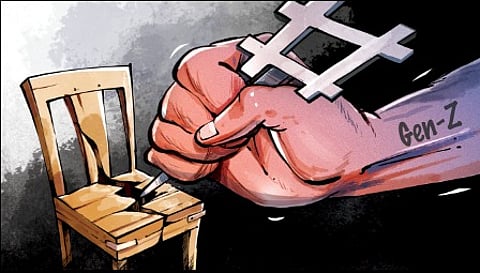

The recent convulsion in Nepal began as a backlash against a social media ban and rapidly became something far larger—a Gen Z eruption that struck at the symbols of state and elite power, left scores dead, and ended with the prime minister’s resignation and the army moving into the capital to restore order. Reports showed protesters breaching and setting fire to government installations and homes of senior leaders—an intensity and a degree of targeted action that reads less like improvisation and more like careful preparation, while the intelligence community’s inability to foresee the build-up remains puzzling.
In Kathmandu’s compact political geography, the police’s apparent retreat from key posts and the delayed arrival of specialised units created a vacuum the uprising filled; by then, the spectacle of elite residences and state buildings under attack had already rewritten the political map. A resigned police and army attitude is a blessing at times, as it was here because it helped dilute the anger.
What we are watching is not simply the recycling of old grievances, but the emergence of a new template of dissent. Gen Z operates differently—decentralised digital natives organised through viral content, encrypted chats, and ad hoc collectives rather than through political parties or charismatic hierarchies. The movement’s leaderless mechanics—nobody to arrest to decapitate the revolt, no single body to negotiate with—recall political scientist Gene Sharp’s ideas on decentralised resistance, now updated with social media as the organising architecture. That very structure is liberating for protesters and destabilising for states, because it makes pre-emptive intelligence harder and reactive governance clumsier.
Alongside domestic dynamics, the suspicion of an ‘external hand’ inevitably surfaces; earlier South Asian episodes also prompted similar accusations without conclusive proof. The more productive question is which external powers materially benefit from an unstable Kathmandu—gaining diplomatic leverage, economic foothold, or a security advantage. For now, the winners are domestic: the youth succeeded in toppling a premier, forced policy reversals, and demonstrated quasi-political capability. Allegations at this stage would be conjecture.
Turning to Pakistan, a likely candidate for such an upheaval, the parallels are sobering and instructive. Pakistani media is increasingly haunted by the prospect of political failure compounded by economic collapse and social erosion. Repetitive natural disasters are adding to the misery. The macroeconomic stress is well documented. The social picture accelerates the anxiety. Pakistan’s precipitous ranking at the bottom of the World Economic Forum’s Global Gender Gap report has provoked widespread commentary about the debilitating costs of gender inequality on development, social justice, and human security.
Pakistani op-eds often frame the country’s dilemma as a triple bind. First, economic stress that deepens grievance. Second, a public sphere awash in identity politics and ideological religiosity. And third, the lack of pragmatic problem-solving and institutions that fail to deliver basic services or protect minorities and women. The result is a rising social frustration that bears an uncomfortable similarity to the grievances that fuelled Nepal’s uprising. Add to that a media environment where certain channels and commentators amplify sectarian or ideologically rigid frames that increase the lethality.
The comparison with post-Arab Spring cycle of events is an uncomfortable, but useful, mirror. In Egypt, the popular upheaval led to the election of an Islamist government, which itself collapsed a year later under mass protest and military intervention—a process that devolved into a harsh, polarised settlement. The lesson many analysts draw is that popular revolt can eliminate one set of elites while empowering another, sometimes more radical; the crucial variable is whether the army and other institutions remain professional and committed to protecting the State rather than partisan advantage. In Egypt, the army removed an elected Islamist leader, and what followed was repression and reprisals—a reminder that militaries can stabilise or destabilise, depending on their ethos and accountability.
So, what does this mean for Pakistan’s risk profile and India’s neighbourhood policy? First, Pakistan’s combination of economic fragility, social conservatism with uneven protections, and an often-ideological public discourse does make it susceptible to political shock. The shape of any upheaval will depend on triggers—sudden price shocks, a political assassination, or a social scandal that goes viral—but the flammable tinder is clearly present. Second, the role of the military is pivotal: a professional, apolitical force can act as a buffer against collapse; a politicised, ideological force can accelerate factional outcomes. Pakistani commentary increasingly urges clearer civilian oversight and institutional reform to reduce the cycles of crises that invite military dominance, but such reforms are politically fraught.
For India, the unfolding tableau in its neighbourhood is a strategic and humanitarian challenge. Goodwill, not interference, will pay dividends. Pragmatic support—humanitarian aid, medical assistance, youth skill programmes and credible economic partnerships—will build sticky ties of affinity with citizens, especially youth, who are the agents of change. Diplomatic humility is crucial. In divided societies, heavy-handed interference often sparks nationalist backlash and drives people toward radical options. India’s best bet is to be seen as a partner in resilience, not a patron of any particular political faction; the Bangladesh experience remains in mind.
Nepal’s uprising and Pakistan’s simmering crises together map a region in which leaderless youth mobilisations, institutional frailty, and the interplay of ideology and economics create novel faultlines. The Arab Spring taught us what guarantees stability is not the suppression of dissent, but the strengthening of institutions that can translate popular energy into accountable governance.
South Asia’s future will be shaped as much by what governments do to absorb youth aspirations as by what external actors do to respect sovereignty. If states adapt—opening opportunity, reforming institutions, and protecting rights—then Gen Z’s impatience can become a force for renewal rather than rupture. If they do not, the region may see more of what happened in Kathmandu and, potentially, more outcomes that echo the worst ambiguities of the Arab Spring.
Lt Gen Syed Ata Hasnain (retd) | Former Commander, Srinagar-based 15 Corps; Chancellor, Central University of Kashmir
(Views are personal)
(atahasnain@gmail.com)