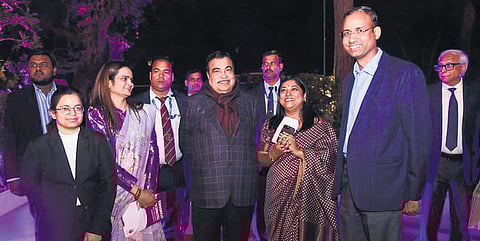

VISAKHAPATNAM: Developed by the Andhra Pradesh MedTech Zone (AMTZ), Union Minister for Road Transport and Highways Nitin Gadkari has launched the Purple Building Certification Scheme, the country’s first dedicated accessibility rating system for public and private buildings.
The initiative has been developed by AMTZ, in collaboration with the Indian Council of Medical Research (ICMR), and the Inclusive Divyangjan Entrepreneur Association (IDEA). The launch coincided with the International Day of Persons with Disabilities, observed on December 3.
Gadkari called for making accessibility a legal requirement for all buildings and public spaces. He suggested that NITI Aayog draft a proposal for mandatory standards, and that the Ministry of Social Justice and Empowerment prepare a Bill to be introduced in Parliament. “Mandatory provisions will help ensure compliance, and empower people with disabilities,” he said.
He also commended AMTZ and ICMR for developing the certification framework, noting AMTZ’s growing role in setting standards for affordable medical technologies.
Explaining the development of the framework, Dr Jitendra Sharma, MD and founder-CEO of AMTZ, said accessibility must become a basic feature of infrastructure. He noted AMTZ, aligned with International Accreditation Forum standards, will work with the Quality Council of India (QCI) to train auditors and certification bodies. Expert committees supported by ICMR contributed to designing the standards.
At the event held in New Delhi, NITI Aayog member Dr VK Paul suggested that the government adopt the certification in its own buildings to set an example.
Dr Mallika Nadda, president of Special Olympics Bharat, opined that accessible infrastructure is essential as India prepares to host major international sporting events.
The Purple Building Certification Scheme is a voluntary national programme that evaluates, and recognises accessibility in schools, hospitals, transport hubs, commercial complexes, recreational facilities, and residential spaces.
It aims to integrate universal design principles into India’s expanding urban landscape, benefiting persons with disabilities, senior citizens, pregnant women and people with temporary or permanent mobility or sensory needs.
Officials from the Department of Empowerment of Persons with Disabilities emphasised that accessibility should be treated as a shared responsibility across ministries.