
If I had a rupee for every time a Bollywood producer looked at one of my scripts, stroked his chin thoughtfully, and said, "The only problem with your film is, it has got a female lead", I'd have enough money to produce the damn thing myself. And probably have a female-led sequel already in the works.
It's a refrain as familiar as a background score in a '90s romantic scene. Most of my spec scripts—passion projects written on stolen time and fueled by irrational hope—feature a woman at the helm. I can't help it. I find the typical male protagonist, with his fragile ego wrapped in oversized ambition, about as exciting as watching paint dry on a superstar's vanity van.
Women, however? Ask any screenwriter who has actually dared to listen to the women in their lives, and they'll talk of entire, sprawling, chaotic, and magnificent wonderlands of narrative. Every woman I've known—the ones who’ve loved me, and the ones out to lynch—has been a deep, enigmatic ocean. My job isn't to conquer that ocean, but to sit humbly on the shore with a notebook and listen. The stories wash up like tidal waves.
But a female-centric story and Bollywood? Forget about it.
Its entire ecosystem is fundamentally philosophically wrong for it. The underwhelming performance of a film like Jigra was treated not as a single data point, but as a divine commandment from God itself: "Thou Shalt Not Bankroll a Woman's Journey." It doesn't matter that the cinematic landscape gets littered with the smouldering carcasses of a hundred male-starring flops every few months. One woman-led film stumbles, and the entire industry chorus goes: We told you!
This entrenched, self-fulfilling prophecy is precisely why I had to go see Lokah Chapter 1: Chandra.
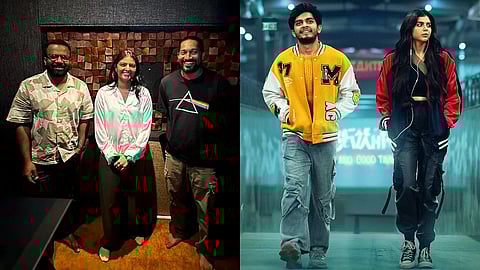
Not only is it India's first proper female-led superhero action film (no, a woman with a gun in a gritty drama doesn't count), but it's audaciously titled Chapter 1. They’re building a universe. A cinematic universe led by a woman? And the producer, the wonderfully talented and seemingly sane Dulquer Salmaan, publicly stated he was ready to lose money on this vision? And now, in a move that likely caused cardiac events in several Mumbai high-rises, he wants to share the profits with his team?
HAVE THESE MAD, MAGICAL MALLUS LOST THEIR COLLECTIVE MARBLES?! Every Bolly producer must be fuming at the 'dangerous precedent; this might set.
The film itself is, as my brilliant screenwriter friend Arpita Chatterjee aptly put it " might have been made for Rs 30 crores but has the look and feel of a film made on a budget ten times that".
Lokah is a living monument to where the money actually goes when a superstar's entourage does not vacuum it up. But the other reason Arpita, I, and millions of others loved it is its delicious subversion of some of the oldest tropes. The damsel in distress? The film gives us a "dude in dire danger". Our hero, the charming but decidedly non-super Sunny Kurian, has to be rescued. Repeatedly. From speeding cars, from his own poor decisions, from goons. It's refreshing, it;s funny, and it subtly tells the audience: it's okay for a man to not always be the strongest one in the room.
Another subversive aspect for spoon-feeding Bollywood: for a full, glorious hour, the film masterfully teases us. Who is this girl, Chandra? What is her power? We see her perform these minor miracles—a breathtaking car rescue, shutting down a Kabir Singh-level obsessive lover with testosterone-fuelled violence, and most cathartically, rescuing herself from an attempted rape with brutal, justified finality. This alone is such a revolutionary act in mainstream Indian cinema that it deserves a standing ovation. If you haven't seen it yet (I saw the flawless Hindi dub), you are actively depriving yourself of a good time and an important cultural moment.
The visuals are stunning, the production design is immersive, the action is coherent and impactful (a novelty!), the VFX are actually… good? The world-building is meticulous, and the soundtrack slaps. No wonder that despite its so-called "disadvantages"—female lead, Malayalam language, stars unknown to the Hindi heartland—the film has become a box-office tsunami, raking in over Rs. 250 crore globally. It's the biggest Malayalam hit ever and is now eyeing the records of legendary female-led films, such as Mother India. The "Jigra curse" might just be lifting, one super-powered Malayali woman at a time.
INTERVAL!!!
Welcome back. Now, much as I'd love to, I can't just pack my bags and defect to the Malayalam industry. My favourite school friends were mostly Mallus, and while I mastered the art of devouring their lunch boxes, the language largely remained a beautiful, melodic mystery. So, I'm stuck here in Bollywood, left to wistfully fantasise the following: What if writer-director Dominic Arun and cinematographer Nimish Ravi had walked into a typical Bollywood studio with the Lokah script?
Let's play that out, shall we? A little game of "Bollywood Producer Roulette".
Meeting 1: The 'Suggestive' Mogul
The famous producer with massive 90s hits, leans back: "We love it! It's fresh. It's bold. Really cutting-edge. But… have you considered casting someone whose gender starts with the letter 'm' and whose last name ends with a 'K'?"
The innocent, wide-eyed creators would blink. "You mean… a mermale? With the surname Kulkarni? Kohli? Kher? Kashyap?" Not getting the "nepo-baby" hint, they would be gently but firmly escorted out by a security guard.
Meeting 2: The 'Item Number' Innovator
This producer, a man who believes "subtlety" is a great name for a detergent brand, not a cinema treatment, would quip: "So she's a superhero… fantastic! But to really connect with the masses, can't she also do a sensuous item number where she shows, say, 95% of her body, but cleverly hides the… you know… the vitals? The power sources?" The team would stammer, "But sir, the film is about trauma, resilience, and finding one's identity!" "Exactly!" he'd boom, "So we'll add a song called Beedi Jalaile, Chameli Chingari Hai and shoot it in Dubai! Nothing sells trauma like glitter and slow-motion hair flips. Trust me, I've made 14 hits."
Meeting 3: The ‘Progressive’ Stalker
Another studio, another genius: "Okay, I get it: no love story. Bold choice. But what if… and hear me out… she's a lesbian? And she uses her superpowers to stalk the girl she loves? It's progressive! And think of the revenue! Stalking women in films is a proven Rs 50-crore business model with our core male demographic. This way, we get both woke points and the non-woke’s money!"
Meeting 4: The Algorithm Acolyte
At a sleek, ultramodern studio, a young executive would stare at data projected on a wall entirely made of touchscreen. "Kalyani Priyadarshan… her social media metrics are… adequate. But our AI suggests that Miss Little Kunchum has 1.07 crore followers across all platforms. The data doesn't lie! Cast her. Even if we make half the film you've written, and even if only half her followers show up, the math works!"
A bewildered Dominic would ask, "But how can you be sure?" The exec would smile a cold, data-driven smile. "Sir, we make half the films and series you see by surgically removing creators' visions, and our numbers are fantastic. The algorithm is never wrong."
Ok! Enough of the dream sequence. Back to reality. Now, sure, you could cry nepotism about Lokah, too. Dulquer is Mammootty's son. Kalyani is Priyadarshan's daughter. But here's the crucial difference: nepotism is simply inherited power. It’s not inherently evil; it’s about what you do with it that makes it good or bad.
Do you use that platform to launch more of the same, to create an echo chamber of privilege? Or do you use it as a force multiplier for good stories, for inclusive agendas, for genuine creativity? Dulquer used his clout to back a radical vision, empower a new director, and create a new action star in Kalyani on her own terms. And then, in a move of sheer class, he announced he will be sharing the profits.
Can you, for a single second, imagine a Bollywood star kid or mega-producer doing that? Even if they agreed to be in or fund such a film, would they ever, ever share the profits (Okay, exceptions like Excel Entertainment and Aamir Khan Productions are not spokespersons for all)? Or would they, like a few stars do, take 90% of the budget upfront, leaving the actual film to starve?)
This brings us to the core of why Lokah soared while so many Bollywood spectacles crash and burn. It started with a clear, compelling vision from Dominic Arun, one rooted in Indian culture, myth and ethos despite taking elements from the West. The visual brilliance of Nimish Ravi enhanced it. And most importantly, producer Dulquer Salmaan’s role wasn’t to curb that vision, but to expand it. He was a patron, a collaborator, and a shield. He was ready to lose money but not compromise on the soul of the film.
In Bollywood, that vision would have been put through a meat grinder of executive "notes". A dozen people who have never written a word of dialogue would have tried to impose their "brilliant" ideas on what a superhero film "should" be. "Shouldn't she be more glamorous?" "Can the sidekick be a comic relief who speaks in Punjabi?" "What about a cape? A mask at least?" "The theme is too dark; make it more family-friendly." These notes aren't suggestions; they're death by a thousand cuts—one that has hacked many films, and creative directors and producers.
The culture in Bollywood is fundamentally broken. Writers are often paid less than the makeup artist or bodyguard in a lead actor's entourage. Producers are too busy managing the cosmic egos of their stars to actually, you know, produce a good film. The star sucks up the budget, the project is rushed, the VFX are outsourced to the lowest bidder, and the final product is a hollow, ugly mess. And then they have the audacity to blame the audience.
The mantra for Bollywood's revival is embarrassingly simple. It's not more stars, bigger budgets, or more remakes. It's this: Trust creativity. Reign in greed. Believe in the writer, the director, the cinematographer, the editor. See them not as expenses, but as investments—like Dulquer is doing. See the producer not as a glorified accountant, but as the guardian of a vision. And for heaven'’s sake, put the story above the star.
Audiences today, armed with a world of content in their pockets, don't care about your last name. They care about a good story. Give them that—as Lokah and films like Saiyaara did—and they will come. They will come from every corner of the country, regardless of language, to watch a well-told tale. Focus on content, empower creativity, and maybe, just maybe, Bollywood can learn to build its own universe instead of trying to tear everyone else's down.