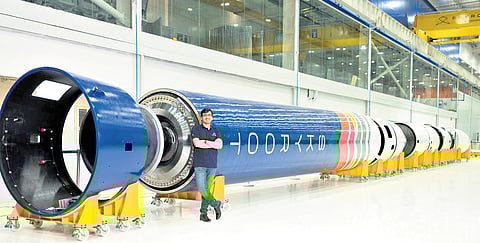

Skyroot Aerospace has taken a major step in India’s private space journey with the launch of its advanced Infinity Campus in Hyderabad — a facility built to produce one rocket a month. Unveiled by Prime Minister Narendra Modi alongside the flight-ready Vikram-1 launch vehicle, the campus signals India’s push for a bigger share of the global satellite launch market.
Calling it a symbol of new-age innovation and youthful ambition, the prime minister praised Skyroot CEO Pawan Kumar Chandana and said the company had become an inspiration for aspiring space entrepreneurs.
In an exclusive conversation with TNIE, Pawan Kumar — a former ISRO scientist — traces Skyroot’s rise from a startup idea to a global launch contender, breaks down the tech behind Vikram-1, and outlines the road ahead towards reusable rockets and the goal of “opening space for all”.
Excerpts:
Congratulations on the unveiling of Infinity Campus and Vikram-1. To begin with, could you tell us more about the campus — its mission, capabilities and how it will shape Skyroot’s future?
Infinity Campus is India’s largest private rocket manufacturing facility. It has been designed to produce one orbital-class rocket — the Vikram-1 — every month. This will significantly enhance our launch frequency and increase India’s share in global space and commercial launch markets.
The campus is equipped with state-of-the-art infrastructure for world-class rocket development and production. Phase 1 spans 2 lakh sq. ft., and we plan to expand to 3 lakh sq. ft. soon. Its location near the Hyderabad airport ensures operational convenience and rapid logistics.

The facility has the capability to deliver one rocket per month, a scale we will reach over time as production streamlines. Now that it is inaugurated, our focus is to get there as quickly as possible.
Skyroot aims to launch one space vehicle a month. How strong are the global and domestic markets for commercial launches? What kind of demand and revenue potential do you foresee?
India has set an ambitious target of a USD 44 billion share of the global space economy by 2033. That is the opportunity we want to tap into. Launch capability is a critical part of that vision. The prime minister has also set a goal of 50 launches per year by 2030.
A market of 50 launches annually represents a revenue opportunity of over USD 2-3 billion from launch services alone. That is the space we are preparing to serve and lead from India.
How would you describe Skyroot’s journey from a small startup to operating from a world-class aerospace hub?
It is a dream come true. When we started, we never imagined growing this big, launching India’s first private rocket. Now we are on the cusp of deploying India’s first private commercial orbital rocket.
Several forces enabled this journey. First, the government’s space reforms opened the sector to private players. Second, our investors believed in us — visionary entrepreneurs early on and later global giants like GIC and Temasek — who empowered us with resources and confidence. These two forces became major catalysts.
Importantly, India has built a strong aerospace ecosystem over 60 years through ISRO. For Vikram-1 alone, more than 400 Indian manufacturers supply components — a testament to decades of national progress.
Global players like SpaceX are reshaping commercial space access. What is Skyroot’s differentiation strategy?
Although SpaceX and Skyroot are both launch companies, our focus areas and customer segments differ. Vikram series rockets are small-sized rockets for dedicated launches.
Think of SpaceX as the train to space — large payloads moving between common orbits. Skyroot is the cab to space — for customers who want customised orbits, unique inclinations or specific altitudes. You book a cab when you know exactly where and when you want to go; you use a train for hub-to-hub travel, like Delhi or Mumbai.
These segments don’t compete directly. Trains and cabs coexist. Our Vikram series is a cab to space, optimised for dedicated small-satellite missions with precision delivery and flexible scheduling. That is our edge.
Vikram-S was a success. Where does Vikram-1 stand compared to ISRO’s PSLV and SpaceX’s Falcon series in performance, innovation and cost? Will it include reusable features?
Vikram-1 brings multiple firsts to India. It is the first Indian rocket built entirely using carbon composites, making it exceptionally lightweight and enabling higher payload capacity. It will also be the first Indian orbital rocket powered by a 3D-printed engine.
Globally, carbon composite rockets are among the most advanced, and Skyroot will be the first to build a rocket entirely with carbon composites, while many rockets — including some from SpaceX — still rely on heavier metals. This places Vikram-1 among the most modern and efficient launch vehicles in its class.
Reusability will be introduced in our future, larger launch vehicles, already part of our roadmap.
The PM praised Skyroot as an inspiration for India’s youth. What is your message to students aspiring to enter aerospace and aeronautics?
The future belongs to space, aerospace and deep-tech hardware innovation. For years, much of India’s talent moved towards IT services, but with AI transforming that sector, new growth will come from core engineering. AI has disrupted IT, and students may have fewer opportunities there.
My first message is for students to choose aerospace and cutting-edge engineering as their prime careers. Stay focused, think long-term and help build the nation’s technological future.
My second message is that India needs more entrepreneurs. Nearly 50% of our population is under 25. To create jobs, build global innovations and achieve Viksit Bharat by 2047, we need founders willing to take risks. Many dream of startups, but few take the first step — take that step and contribute to India’s rise.
Looking ahead, what is the long-term vision for Skyroot? Are fully reusable rockets and rapid launch turnaround on the roadmap?
Absolutely. That is the direction we are headed in. While the Vikram rockets focus on dedicated small-satellite launches, we are developing larger reusable launch vehicles for high-frequency, cost-efficient access to space.
Our long-term vision is ambitious but simple — to open space for all. This will happen step by step, from small-satellite launches today to high-cadence reusable missions in the future.
India’s private aerospace ecosystem is still evolving. Does Skyroot already possess the required technology capabilities, or are collaborations part of the plan?
As a strategic and sensitive sector, our preference is to develop core technologies in-house, ensuring full control. However, we will collaborate closely with customers launching satellite constellations to meet evolving mission needs.
So, while technology development remains largely internal, customer-driven collaborations are part of our strategy.
A curiosity — reports of unidentified flying objects keep surfacing. From an aerospace researcher’s standpoint, do such sightings drive scientific inquiry or technological exploration?
Science is the method to understand everything, including unexplained sightings. Whenever there is an observation, we must investigate with evidence, not speculation.
As a scientist, I believe the probability of extraterrestrial life is high given the vast number of galaxies, stars and planetary systems. But until we find proof, these remain fascinating questions that require proper scientific investigation. Truth must come through the scientific method.
Finally, what does your customer pipeline look like? How will Vikram-1 compete on cost efficiency?
Vikram-1 operates in the dedicated small-satellite launch segment — the cab to space. Our goal is to be the most cost-competitive launcher in the world in this category.
We won’t quantify pricing yet, but delivering high performance at globally competitive costs is core to our mission.