
In the complex tangle surrounding conflict in Ukraine, things are moving in the direction that Russian President Vladimir Putin would have, conceivably, told Prime Minister Narendra Modi in strictest confidence during their 50-minute conversation while travelling together in the Aurus Senat, the presidential limousine retro-styled after the legendary ZiL used by Soviet leaders. They were heading towards their September 1 meeting at the American luxury hotel Ritz-Carlton in Tianjin, China, where the Russian delegation was staying.
For Putin, it must have been a moment out of the Psalms: “Blessed is the man to whom the lord imputes no guilt, in whose spirit is no deceit.” As a deeply religious man, it must have been of the utmost criticality for Putin to hold Modi’s hands away from the prying eyes of western intelligence at a sensitive juncture when India had come under immense pressure “just as in the colonial era”, as he later told a small group of Russian journalists in Beijing.
Putin told the journalists, “You know, when people from outside say, ‘We are going to make things hard for you and punish you…’ How are the leaders of these countries (India and China)—large economic powerhouses which have lived through very rough periods in their history, periods of colonialism and attacks on their sovereignty over a long historical period— supposed to react to that?”
Anyway, it took just a few days after the ride in Putin’s limo for the US President Donald Trump to make his first overture to Modi on September 5, when he told reporters at the White House, “I will always be friends with Modi. He is a great prime minister. India and the United States have a special relationship. There is nothing to worry about.”
That was an incredible turnaround in international diplomacy. But clearly, Trump’s mind was already turning and turning in a widening gyre as he had written on his Truth Social post the previous day that India and Russia had been “lost” to “deepest, darkest China”—adding, unflappably, in his characteristic prose style of massive ellipses that often give his words the ring of an oracle: “I don’t think we have. I get along very well with Modi. As you know, he was here a couple of months ago, we went to the Rose Garden.
Modi kept his part of the bargain with Putin and is skipping the UN General Assembly, which Trump is certain to address. Highlighting Delhi’s close ties with Moscow, an Indian contingent is participating in the Russia-Belarus Zapad-2025 military drills to test the two countries’ combat readiness amid growing tensions with Nato.
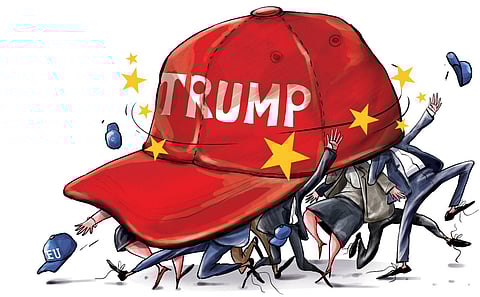
The events surrounding Ukraine are in a torrential flow. Trump has cracked the whip at the European Union and Nato, who were punching above their weight since his meeting with Putin in Anchorage on August 15, which was a turning point. Trump and Putin had agreed that a ceasefire in Ukraine should be sequenced after a peace settlement, rather than be a ‘standalone’ putatively heart-warming pause in the fighting, fragile and fraught.
So, the fighting in Ukraine may likely run its course through the year— that is, unless the regime in Kyiv collapses, or has a change of heart and engages with Russia. The latter is predicated on the willingness of the Machiavellian interventionists of Western Europe to let Kyiv go, or are driven out militarily from Ukraine. Trump is striving hard to put the EU and Nato on the defensive.
The European allies aimed to disrupt the momentum of the Anchorage accord and pull aside Trump from his agreement with Putin by floating the idea of a US-led ‘security guarantee’ for Ukraine. But Trump saw through the EU ploy to prolong the war and shot it down. Thereupon, the EU came up with Plan B in the nature of imposing draconian sanctions against Russia, in coordination with Washington, with the expectation that it will infuriate Moscow and prompt it to escalate the conflict, which of course eminently suits Nato and the hardliners in EU leadership.
But Trump already had a riposte in mind. Sensing that the EU and Nato hardliners in Brussels are moving in tandem to undermine any Russian-American ‘entente cordiale’ in the endgame in Ukraine, Trump switched to what New York businessmen might call the ‘judo business strategy’—that is, no biting, punching, kicking, gouging, or even head-to-head struggle, but to simply move sideways to bring the highflying Brussels hawks ‘in’.
In a stunning manoeuvre, Trump threw his weight behind Plan B to impose “very strong” sanctions on Russia but added a caveat—the EU should first stop all energy imports from Russia; impose 100 percent secondary sanctions on China; and all Nato member countries should also fall in line. Therein lies the catch, since out of the 27 EU member states only 23 are in Nato, and six European states are Nato members but not of the EU (and they include Turkey, which is heavily dependent on Russian energy supplies).
In reality, Trump’s offer to the EU is a feint, a zugzwang, a manoeuvre—call it what you will—designed to distract and mislead. His conditions are unlikely ever to be met. Politico has run a scorecard on Trump’s ruse, as things stand at the moment, and predicted that the conditions are actually deal breakers. Trump’s game plan is to create space and time to navigate the peace process with Putin, going forward. He intends to speak with Putin shortly. There’s going to be a foreign minister-level meeting on the sidelines of the UN General Assembly in New York as well.
Meanwhile, Fortuna, the ancient goddess of luck in Roman religion, is smiling at Trump, as the troika that masterminded Europe’s forever-war strategy in Ukraine—France, Germany and the UK—are descending into political and economic chaos.
Trump judged correctly that even 80 years after the Second World War, Europe’s security still rests on the American president to backstop it. He has forced the EU to postpone indefinitely its package of sanctions against Russia. Having tasted success, Trump hopes to frog-march Ukraine President Volodymyr Zelenskyy to the negotiating table. On Tuesday, he insistently repeated several times like an oracle: “Zelensky’s gonna have to make a deal.”
M K Bhadrakumar | Former diplomat
(Views are personal)