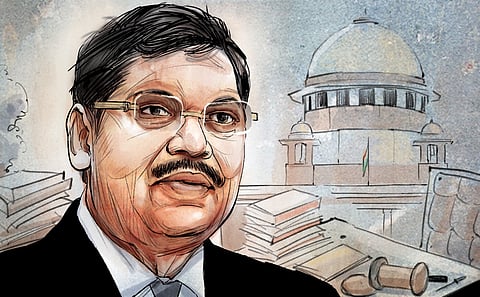

In his 1958 essay on the need for judges to retire, James C Sheppard used the memorable phrase “the age of judges and judges of the ages”. The 52nd Chief Justice of India, B R Gavai, retires on November 23 on account of his age. ‘Judges of the ages’ emerge only rarely, based on the seminal contributions made to the nation and to humanity at large. It requires courage, conviction, and a great level of judicial integrity, accompanied by all other judicial virtues.
Let’s start the summation of Justice Gavai’s era near its end. His latest pronouncement, on the presidential reference, realised the issues correctly, yet provided no solutions. Though the permissibility of judicial review over gubernatorial delay was acknowledged in Thursday’s judgement, by rejecting the idea of deemed assent, he negated the pragmatism in the Tamil Nadu governor’s case. Deemed assent is a constitutional imperative in situations of extreme delay. It also averts the situation of erring governors facing action for contempt of court. The Constitution Bench led by Justice Gavai missed this cardinal aspect.
This week, his Bench also struck down the Tribunal Reforms Act, 2021 whose provisions attempted to create executive dominance in India’s tribunal system. As such, it was an assertion of judicial independence.
As a judge of the apex court, Justice Gavai was part of the Bench that validated the abrogation of the special status of Jammu and Kashmir. By the time it was decided, the case had practically become infructuous, as the state’s special status had been irrecoverably abolished by then. Again, he was part of the Bench in the Association for Democratic Reforms (2024) case that struck down the dubious scheme of electoral bonds. His endorsement to the 2016 demonetisation scheme in 2023 was practically inconsequential; the delay in adjudication was, however, not attributable to him.
He has acted in situations that were ostensibly unjust and inconceivable. In Rahul Gandhi vs Purnesh Ishvarbhai Modi (2023), it was a Bench led by Justice Gavai that stayed the conviction and sentence of the leader of the opposition in the Lok Sabha. The court considered the serious ramifications on Section 8(3) of the Representation of the People Act, 1950, contemplating disqualification of parliament membership based on the conviction. He upheld not only the right of an elected MP, but also that of the electorate who wanted him to represent them. His Bench’s intervention averted an unprecedented tragedy of an MP being disqualified for the conviction and maximum punishment imposed in a case based on a private complaint. The bail order he issued to activist Teesta Setalvad also had a libertarian message.
With In Re: Directions in the Matter of Demolition of Structures (2024), dealing with states’ unsanctioned bulldozer action on its citizens’ properties, he reminded the states how their mischief overturned the very idea of the rule of law—one of the fundamental principles of our democracy. The partial stay granted by him on the Waqf (Amendment) Act, 2025 reflected his readiness to interfere in cases of majoritarian onslaught, so as to keep a fine balance between parliament’s power and the limitations imposed on it by the Constitution.
In environmental cases, at times, only extreme judicial postures can lead to moderate solutions. The requirement for environmental clearance before commencement of potentially hazardous projects was underlined in a 1994 Environment Impact Assessment Notification issued by the Centre, followed by another notification in 2006. The Vanashakti judgement of May 2025, which prohibited the Centre from granting ‘ex post facto environmental clearance’ was a radical measure intended to protect the nation’s fragile ecosystems.
That Chief Justice Gavai chose to review and recall the judgement at the behest of the Centre and others is highly dispiriting. Justice Ujjal Bhuyan’s dissent in the case is an exposition of the fragilities of the course adopted by the Chief Justice. Charles Evans Hughes, Chief Justice of the US in the 1930s, said, “A dissent in a court of last resort is an appeal to the brooding spirit of law, to the intelligence of a future day.” Chief Justice Gavai’s indulgence towards ‘green crackers’ during this year’s Diwali also had an adverse impact on Delhi’s already contaminated air.
Like many of his predecessors, Chief Justice Gavai occupied the highest position in the country’s judiciary only for a short period. Yet, this was a significant time when India’s judicial system begun to transform itself into an executive court and an executive’s court, as scholar Gautam Bhatia called it. How far this Chief Justice could assert against a mighty executive is a pertinent question. On the judicial side, he could do it in many cases, though not in all.
On the administrative side, by acting as the master of the roster, he permitted a Bench led by Chief Justice designate Surya Kant to allow the special intensive revision (SIR) to happen in Bihar, without addressing the basic legal challenge against the process based on the provisions in the Representation of the People Act. Now SIRs in several other states are coming up for consideration before the Supreme Court. Allotment of cases to a particular Bench cannot be a matter of public opinion. The impact of the rulings by any Bench on the country’s democracy cannot be lost sight of. This is how the Chief Justice, as the master of the roster, becomes a centre-point of attention, even in cases where he was not a party.
Chief Justice Gavai maintained the online court system, the most radical administrative reform in the Supreme Court initiated by the previous Chief Justice D Y Chandrachud. Chief Justice Gavai’s reluctance to facilitate enough number of Constitution Benches has been a matter of concern.
In conclusion, one may not be able to describe him as a judge of the ages. He did his best to distance himself from a self-intensifying executive. His gesture against post-retirement avenues for judges, made in the public domain, is remarkable. The judicial maturity that he presented in the shoe-gate incident was commendable. Pursuant to the offensive act, in a caste-ridden society, he placed himself above such prejudices with an ethically-strong silence. He did not give an impression of acting in tune with the regime’s dictates.
After all, we live in an age when judges who try to disassociate with the regime of the day deserve to be appreciated and acknowledged on that count alone.
Kaleeswaram Raj | Lawyer, Supreme Court of India
(Views are personal)