
It is commonplace to say that Mohandas Karamchand Gandhi made deep connections and commanded a loyal following not just within India, but from outside too. But it is true that only a few of his friends and collaborators in faraway lands are remembered and celebrated. Many significant ones have, over time, quietly gone behind the curtains of amnesia.
A new generation of Indians may benefit from their resurrection with a simple hope that it may cross-pollinate a new wave of idealism that may anywhere be in the making. But then, idealism itself has not remained a simple construct anymore. It is difficult to say if we are in the age of ruinous indifference or deliberate pragmatism. Perhaps this is unfair cynicism when it is the 156th anniversary of Gandhi’s birth tomorrow.
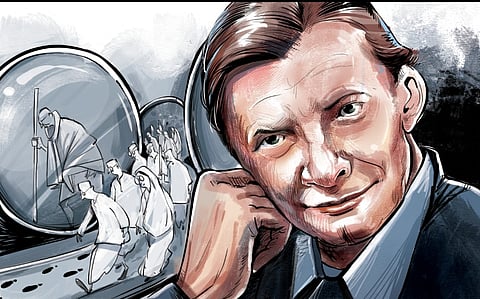
As the violence of words and the noise of war engulfs us, when a whole category of idealists who were seen as conscientious objectors of war, as pacifists, peaceniks and disarmament activists have become extinct, it may be relevant to recall on Gandhi’s birthday one of his most devoted and significant Quaker friends and followers: Horace Alexander. He was a Britisher who had shifted to the US in the late 1960s and lived there to be centenarian. He was 20 years younger to Gandhi, and till the very end evaluated everything he saw with a sparkling Gandhian lens.
Alexander visited India for the first time in 1927-28, and was introduced to Gandhi by none other than Charles Freer ‘Dinabandhu’ Andrews. Andrews had written to Alexander in September 1927 from Rabindranath Tagore’s Shantiniketan on how to track and meet Gandhi while in India. Alexander met Gandhi for the first time in March 1928 at the Sabarmati ashram.
However, the primary reason for Alexander’s 1927 visit was not to see Gandhi. Andrews had persuaded him to fight the opium addiction in India from which the British government derived a large revenue. While at the League of Nations conference the same year for the limitation of drugs, Alexander had received a wire from Gandhi, the first serious communication between them, which urged him to tell the conference that India wanted prohibition of drugs except for medicinal purposes.
Later, in 1931, when Gandhi went to London for the Round Table Conference, Woodbrooke, a Quaker institution in Birmingham, sent Alexander to assist Gandhi at his London office. That was the beginning of a purposeful and lasting relationship. By 1942, the friendship between Alexander and Gandhi had deepened, but Andrews, their common friend, had passed away. It is then, at the Sevagram ashram in Wardha, that Gandhi asked Alexander to keep his conscience: “I want you to do for me what Andrews used to do. Since he died two years ago, I have had no one to tell me when what I propose to do might alienate British people. I don’t want to do that. I want to win them. You must take Andrews’ place.”
Significantly, Alexander was with Gandhi when the communal tensions rose in the run-up to India’s partition. On the eve of independence, Alexander had spent time with Gandhi and H S Suhrawardy, the Muslim League chief minister of Bengal, in a deserted Muslim home in the Hindu quarter of Calcutta, where Gandhi persuaded a hostile crowd to accept Suhrawardy as a man who had turned his back to communal violence. He negotiated a tricky peace in what was seen as a very volatile and dangerous moment. Suhrawardy was seen as being largely responsible for the August 1946 Calcutta killings, he had therefore become totally untrustworthy for the Hindu population that comprised half of undivided Bengal. During this trying moment, Alexander brought a unique perspective and balance to Gandhi’s thought process.
Marjorie Sykes, another Quaker Gandhian, wrote about this moment: “Alexander continued to feel goodwill towards Suhrawardy, and when Gandhi said the chief minister was a bad man, Alexander reminded him that like most people he was good and bad in parts. ‘Like Jekyll and Hyde’ was Gandhi’s response, agreeing that Stevenson’s fiction had some relevance here.” Alexander’s goodwill was because Suhrawardy had played a positive role during the 1942 Bengal famine. Geoffrey Carnall, Alexander’s biographer, had noted in an essay that Suhrawardy, too, had respect for Alexander though he was in the habit of passing dismissive remarks about Gandhi as an “old rogue who deceived simple-minded foreigners”.
Even during the Cabinet Mission of Stafford Cripps and Frederick Pethick-Lawrence in 1946, Alexander had offered Gandhi valuable inputs. He had tried to correct the ‘thoroughly jaundiced view’ of the Congress towards the Muslim League when the negotiations were happening. Later, a month after independence, when Alexander saw Gandhi almost daily, on one occasion “pleaded and argued with him to be less belligerent for nearly 20 minutes”. This was when there was some talk of a war between India and Pakistan and “even Gandhi seemed to endorse the idea for a time”, Carnall wrote.
When India was at the threshold of freedom it was Alexander’s idea that India should host the World Pacifists Meeting in Gandhi’s Sevagram ashram and Tagore’s Shantiniketan. Gandhi had welcomed the idea but wanted it postponed until after independence. It was planned for January 1948, the month that Gandhi was assassinated. It was held later, in December 1949.
Much later, in 1975-76, Alexander opposed the imposition of Emergency by Indira Gandhi essentially because it went against everything that M K Gandhi stood for. Eventually when the Emergency was lifted and Indira Gandhi was defeated in the 1977 polls, he wrote in a letter to The New York Times with a certain sense of vindication: “Where does this political courage [in the Indian people] come from? I believe that answer must be: first and foremost from Mahatma Gandhi.” He then went on to describe how Gandhi had instilled fearlessness in the Indian people: “This is a revival of the values Mahatma Gandhi tried to realise. Politics, he insisted, must be a branch of morals.”
Was there a revival of Gandhian values in 1977? Has there since been a serious effort to see politics as a ‘branch of morals’? It is perhaps best to postpone cynical questions.
Sugata Srinivasaraju | Senior journalist and author of The Conscience Network: A Chronicle of Resistance to a Dictatorship
(Views are personal)
(sugatasriraju@gmail.com)