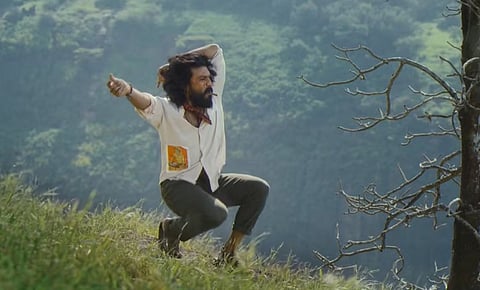

Some films arrive like VVIPs at an election rally. All pomp and entitlement. Others, like Peddi, wander in like a gaily-coloured street drummer—kicking up dust, making up for the lack of hoardings and arranged crowds with sheer life and loud self-declaration. People form circles around them, unable to resist the charm. Ram Charan’s latest is the latter kind of storm. Within hours of landfall, it had all of South Asia spinning around in a blender, forgetting its billion woes, instantly magnetised by ‘Chikiri Chikiri’—Sridevi’s daughter catching the vibe as if she’s finally shrugged off the weight of inheritance and discovered the freedom of movement.
It was a quake with many epicentres. Kadapa to Colombo, Karachi to Kathmandu—every kasba was rocking to its own bootleg. Bengaluru techies are practising footwork between Jira updates. Dhaka schoolgirls have adopted it as their recess-time anthem. Then Tamil aunties in Singapore started recording reels like college kids. ‘Chikiri Chikiri’ soon mutated, like a superbug pouncing in from some primeval forest, into a transcontinental contagion. Because, why not? The internet likes chaos, and nobody does that better than India. Now, Korean teens are uploading impromptu flash mob versions, as if ‘Chikiri Chikiri’ was always meant for their razor-cut K-pop looks! It’s escaped the subcontinent without bothering to check out.
We’ve seen these eruptions before. Our bloodstream carries strong memories of being colonised by Pushpa—a swaggering epic of the underdog that refused to be tamed by the dictates of ‘good taste’. Allu Arjun, Rashmika… for a while, we were all covered in that red earth, like dappu drummers in a Rayalaseema village.
Peddi is from that same soil—the ‘non-elite’ DNA of popular Indian cinema.
These are not just cinematic events. They are political markers. They tell us, often earlier than pollsters do, where India’s inner ground is shifting.
For over three decades now, the grammar of Indian politics has been changing—2014 was no lightning strike; it was scripted to ride a long, rumbling subaltern tide. For years before that, the old custodians—the pedigreed, permanently-in-government babu class—had found the floor wobbling under their curated carpets. The saffronistas were just quick to spot it and launch a marketable version.
Now, even those who once inherited power like family silver are scrambling to cosplay subaltern grit. Rahul Gandhi has a bit of his father’s pre-political avatar in him, a way with those things where the manual meets the mechanical. But all that jumping into rivers with fishermen, painting walls with daily-wage masons, lending a hand to carpenters—that’s perspiration rediscovered in the self, and recast as performative political language.
Others are to the manner born, natives to the terrain. Mamata Di was an early avatar. Proletarian in practice, not just theory. Long before ‘authenticity’ became a branding strategy, she marched across Bengal in rubber slippers and wiped Left aristocrats like Jyoti Basu and their red-label kingdoms clean off the map. Before her, there were the autochthones. Not city grunge artistes, but real country wrestlers with their mudgars and earthy witticisms. The Mulayams and the Lalus, the pioneers.
Meanwhile, in our proletarianised present, poor Shashi Tharoor, armed only with clipped English and Fabindia kurtas, seems genuinely baffled. And old dyed-in-wool Congressis—who assumed they were born to be in the Rajya Sabha—are sulking like theatre actors denied a part.
This is where the country is at. Those once kept outside the soundproof Chatham Houses of the elite now control the volume knob. Their idioms are loud, impatient, and do not carry English subtitles. You either get ‘Chikiri Chikiri’ or you don’t.
Ram Charan’s character, like Pushpa’s, carries that energy. Peddi isn’t trying to be chic. It only wants to be pulsing with unruly joy, like a village fair that won’t make it to the Condé Nast Top 50 and doesn’t care. It may have all the elegance of a truck reversing in monsoon slush. That’s why it works. It’s people music, it swings hard, it takes us to the jungle, it’s mad enough to make us hop like rabbits, if our knees permit. For a while, it makes us forget the per capita GDP.
Though let’s not romanticise too much: ‘people-friendly’ is now a lucrative commodity, complete with marketing playbooks and algorithms. Authenticity trends, so trends pass off as authentic.
But they do tap into some hidden mother lode. South Asia, long conditioned to mimic Western templates, now produces beats that need no World Bank grant. It’s sui generis, internal and newly self-assured—occasionally overconfident, like a teenager who’s just discovered protein shakes.
The subaltern age isn’t a future messiah. It’s already here—shooting endless reels. Will ‘Chikiri Chikiri’ vanish as fast as it exploded? Probably. Once there was a Kolaveri Di. Remember? But that misses the point. Earlier, Indian cinema observed such characters like anthropological specimens. “Them”. Today, they’re “us”.
Read all columns by Santwana Bhattacharya
SANTWANA BHATTACHARYA
Editor
santwana@newindianexpress.com