
In 1907, two years after his retirement as India’s viceroy, George Nathaniel Curzon gave the prestigious Romanes Lecture, and he chose the title Frontier. Among others, in the rather long lecture script, he elaborated on how the idea of the demarcated, delineated and closely guarded national borders was unknown to the world outside of Europe before colonialism arrived.
The boundaries of non-European principalities were amorphous, and they waxed and waned depending on the power of their rulers. Administrative presence also fades out progressively towards the borders until the domain of neighbouring principalities begins.
That all of India’s modern boundaries are inherited from the British colonial days should serve as a testimony to Curzon’s assertions. These include the Radcliff Line, 1947, the contested McMahon Line, 1914, and even the Durand Line, 1893, the pre-Partition border with Afghanistan. There are more.
The earliest of the British-drawn boundaries is between India and Nepal, drawn by the Treaty of Sugauli, 1816, and after it, the Pemberton-Johnstone-Maxwell Line, 1834, demarcating Manipur’s boundary with the Ava Kingdom (Burma), for it to become India’s boundary after Manipur’s merger in 1949. Even Sikkim, which merged with India as late as 1975, had its boundary with Tibet drawn by the Anglo-Chinese Convention, 1890 (or the Convention of Calcutta), recognising Sikkim as a British protectorate.
Curzon also explains the idea of natural and artificial boundaries. Nearly all political boundaries are artificial, drawn by agreements between neighbouring states or by the conquest of one by the other. Natural boundaries are those determined by natural phenomena such as seas, rivers and deserts. In the modern era, with contests over the jurisdiction of even seas, the idea of the natural boundary is set to become extinct.
Going beyond the ideas of the sphere of influence and sphere of control, he also explains how the British reached new levels of sophistication in fashioning the concept of suzerainty in controlling outlying frontier principalities in British strategic interest. The high point of this was the case of Tibet. Many of these are deemed Protectorate States, principalities which were not annexed but put under strict British control through pliant rulers, and through them build what he referred to as three-layer buffers against neighbouring spheres of influence and control of other European powers, such as the French in Indochina and Russians in Central Asia.
This colonial approach to administration may have suited the convenience of the colonial powers, but they have also left behind festering boundary problems for most postcolonial states. India is no exception. Other than direct contests over these colonial boundaries, there are also less visible discontents.
These have to do with certain blind spots of the colonial administrative outlook, which laid its premium on security and revenue. Bypassed are what James C Scott termed non-state-bearing populations in upland South East Asia, in which a good part of the Northeast would also fall. These are small tribal populations who were then living on subsistent agriculture and as hunter-gatherers, whose loyalties seldom extended beyond their clans and villages, often at war with other clans and villages; therefore, alien to the idea of the state.
After annexing Assam in 1826, the colonial administration claimed the “wild” Assam hills as its territory but left them “unadministered” except for occasional punitive expeditions. Instead, they administered only the revenue plains. They even formally divided the revenue plains and non-revenue hills by drawing an Inner Line along the foothills by the Bengal Eastern Frontier Regulation, 1873. In the course of their rule, the “unadministered areas” came to be “excluded areas” and “partially excluded areas”. This pattern of Assam administration was exported to Burma after its annexation in 1885, and Manipur after it became a Protectorate State in 1891.
Quite inevitably, after the advent of the modern era, as the formerly non-state-bearing populations also began gaining state consciousness and aspired to have one, they found themselves in other established states. They also found themselves spread across boundaries. This has been a major factor behind some of the most enduring insurgencies and ethnic conflicts in the Northeast.
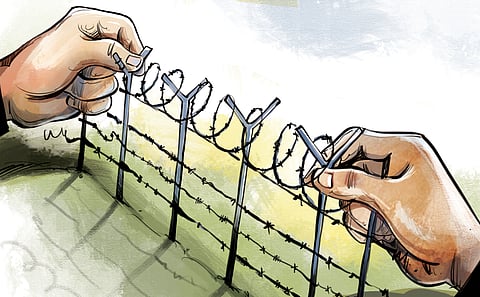
The current protest in many Northeast states over the Centre’s move to fence the Indo-Myanmar border and do away with the free movement regime (FMR) is also a reflection of this. However, this is the reality of the modern Westphalian state that India and all postcolonial nations have inherited. Like it or not, there cannot possibly be a viable alternative to hard borders anymore.
India’s reasons for wanting to fence this border are many, but the most urgent is the civil strife in Myanmar since the February 2021 military coup, and China’s growing influence in the country. Even if the FMR regime is scrapped for good, and the fencing is completed, these borders should remain permeable and a system for easy movements of communities retained, albeit in an accountable way.
Interestingly, the Westphalian model agreed upon in Europe was a means to get over an endemic conflict dynamic. Mohammad Ayoob points out that Europe signed these treaties in 1648 after four centuries of bitter conflicts over overlaps of deemed sovereignties based on ethnicities and faith.
The agreement decided that national boundaries would be the sole determinant of sovereignty. Any person, regardless of faith or ethnicity, who has a legitimate domicile within a national boundary, would be an equal citizen of that state, entitled to all sovereign rights guaranteed by the state.
Even otherwise, the state is an administrative mechanism run on taxes, and services afforded by this tax money are extended back to the citizens. Open, unregulated borders obviously cannot have a place in this scheme. Most Northeast states tend to obfuscate this relationship between tax and citizens, partly because, as special category states, their budgets are not strictly proportionate to the tax revenue they raise.
It is imperative to take cognisance of the inevitability of the Westphalian state reality, and that a secular state, in which religion and ethnicity are relegated to private spheres, is not merely a moral position, but a shared enlightened self-interest.
Pradip Phanjoubam | Editor, Imphal Review of Arts and Politics
Views are personal)
(phanjoubam@gmail.com)