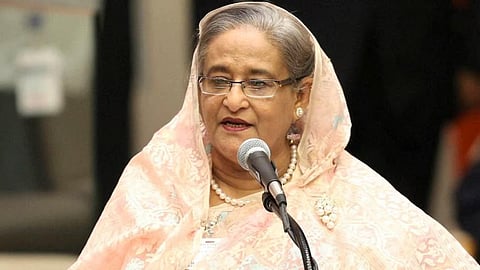

NEW DELHI: Bangladesh’s interim government has cited the India–Bangladesh Extradition Treaty (2013) to request the return of former Prime Minister Sheikh Hasina after an arrest warrant was issued by the International Crimes Tribunal (ICT) for “crimes against humanity." Whether India is legally obliged to comply depends on intricate treaty provisions, exceptions, and India’s domestic law.
Let's break it down.
When is an extradition request valid under Articles 1 & 2?
The India-Bangladesh Extradition Treaty clearly states that a request can only be made if the individual has been charged, accused, or convicted of an extraditable offence. In Hasina’s case, the ICT has issued an arrest warrant in connection with “crimes against humanity.” Legally, this satisfies the minimum procedural condition required for Dhaka to transmit an extradition request to India, which they have.
However, Articles 1 and 2 also hinge on dual criminality. This means the alleged offence must be punishable under the domestic laws of both countries. While “crimes against humanity” is recognised under Bangladesh’s domestic war-crimes framework, India interprets such charges differently, and typically in the context of international tribunals rather than domestic political events. This opens a space where India could argue that the charged offence does not fit the definition required for extradition under its own legal system.
If we go a bit into history about the treaty, it was primarily shaped with two purposes in mind: for Bangladesh, always wanted to go into the unresolved crimes from the 1971 Liberation War, and for India, ensuring the return of militants such as ULFA leaders who were hiding across the border. Perhaps it never crossed the mind of those who have negotiated it that one day such a situation like the current one would arise.
Can India refuse extradition under Articles 6(1) and 8(3)?
The most significant clauses in the treaty for Hasina’s case are Article 6(1) and Article 8(3).
Article 6(1) provides an explicit exception. That is extradition may be refused if the alleged offence is considered an "offence of a political character.” With Hasina ousted by a political uprising and replaced by a Yunus-led interim administration, there are grounds to argue that the accusations, trial, and verdict are inseparable from Bangladesh’s political situation.
Article 8(3) strengthens this discretionary space by stating that extradition can be denied if the request is not made in good faith or not in the interests of justice. Given that the Yunus government is a political adversary of Hasina, India has the option of citing this clause to claim that the charges appear politically motivated.
If things come to such a head, Bangladesh may attempt to invoke Article 6(2), which provides an exception to the political-offence bar. However, for this to succeed internationally or diplomatically, Dhaka would need to demonstrate that the charges were brought in good faith. This might be an uphill task for the interim government.
Is there a mechanism to adjudicate disputes regarding the treaty?
Well, it is a bilateral treaty signed between two sides.
There is no neutral mechanism to adjudicate disputes arising from the treaty. The United Nations cannot intervene in the implementation of a bilateral extradition agreement, and the International Court of Justice (ICJ) can only hear cases with the consent of both governments. This is a highly unlikely scenario in the current context.
That's not all. The treaty itself includes an escape clause in Article 21(3) which allows either country to terminate the treaty with six months’ notice.
How does India’s Extradition Act (1962) come into play?
Beyond the treaty, India’s own Extradition Act, 1962 provides robust legal barriers to surrendering individuals charged in politically sensitive cases.
Section 31 deals with the 'political offence' exception.
This clause states that a fugitive shall not be surrendered if the alleged offence is of a political character. Since Hasina’s removal, trial, and conviction are embedded within domestic political upheaval, India can easily categorise the accusation as political.
Section 29 talks about lack of good faith or interests of justice.
This provision allows India to reject extradition if the request appears not made in good faith, not in the interests of justice, or politically motivated. In other words, these terms closely mirror Articles 6 and 8 of the bilateral treaty. Legally, they offer India a second, independent foundation for refusal even if Bangladesh insists on treaty compliance.