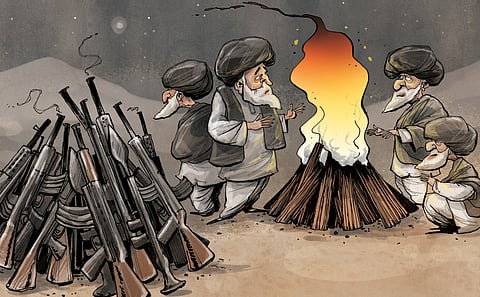

The Durand Line has again become a flashpoint and the rumbles have grown louder over the last two months. First, Pakistan carried out a strike on Kabul in October, which it claimed targeted the head of the Tehreek-e-Taliban Pakistan (TTP). Later that month, skirmishes ensued between the Afghan Taliban forces and the Pakistani military along the 2,640-km border, with casualties claimed on both sides. Qatar and Türkiye weighed in to organise peace talks, but three rounds of parleys ended in a deadlock, though an unwritten ceasefire was agreed upon.
Earlier this month, the fragile truce was shattered when a suicide bomber killed 12 people in Islamabad. A day earlier, an explosive-laden vehicle had rammed into the gate of a military school in South Waziristan. The conflict ratcheted up this Monday, when three suicide bombers targeted the headquarters of a Pakistani paramilitary force in Peshawar, killing six. On Tuesday, a Pakistani air-strike across the Durand Line killed nine children and a woman.
The primary bone of contention between the neighbours is the TTP, apart from Pakistan forcing Afghan refugees to return and blocking Afghan trade routes. Pakistan has accused Kabul of giving safe haven to the TTP, which has claimed most attacks on Pakistan’s forces and civilians in recent years. The outfit, which emerged in 2007 after a merger of various Pashtun factions to assist the Afghan Taliban against the American and Nato occupying forces, has been designated a ‘terrorist’ organisation by the US and the UN working in tandem.
Kabul, which has denied harbouring the TTP, has countered that Islamabad is supporting the Islamic State Khorasan (ISIS-K) and drone flights over Afghan airspace. Pakistan obfuscated the reply because it has agreements in place to allow American drones flying from its bases for surveillance over Iran.
The enmity, however, goes far back from the present—to the disputed Durand Line, named after Henry Mortimer Durand, foreign secretary of colonial India who in 1893 imposed the border to separate Afghanistan from colonial India. The same agreement included Baluchistan in British India.
The line runs through the heartland of the Pashtuns, splitting Afghanistan’s largest ethnic group. An angry Afghanistan voted against the recognition of Pakistan as an independent country at the UN in 1948 and refused to recognise the Durand line. The divisive imprint left by the British has not been accepted by Kabul’s rulers till date.
In recent weeks, Pakistan has accused India of using Afghanistan as a proxy and blamed India for the failure of the peace talks. India has rejected Pakistan’s allegations and suggested that the two sides sort out their problems peacefully.
The cross-border clashes and bomb blasts in the capitals followed Afghan foreign minister Amir Khan Muttaqi’s first visit to Delhi, and India’s decision to upgrade its embassy in Kabul and provide further humanitarian aid. So far, only Russia has officially recognised the Islamic Emirate of Afghanistan. India may follow suit.
Pakistan’s hackneyed playbook of blaming India ignores its historical mistrust with Afghanistan. Pakistan’s confident expectation that under Taliban 2.0, Afghanistan would kowtow to its wishes and support its strategy of using the country for ‘strategic depth’ has been rudely shattered. The closure of trade routes has created economic problems for both. Landlocked Afghanistan has claimed a loss of around $200 million a month owing to the shutdown.
President Donald Trump now has another conflict that he wants to resolve “very quickly”, as he stated at the recent ASEAN summit in Kuala Lumpur. But ever since Trump expressed his desire to reclaim the Bagram air base in Afghanistan, speculation has heightened about America’s intentions. Bagram can allow the US regular surveillance over Iran and Central Asia. Also notable is the US military’s recent joint exercises with the Bangladesh military in Chattogram, close to Myanmar’s border and its use of a ‘humanitarian’ corridor to provide ‘aid’ to the Arakan Army and Rohingyas.
Bolstering these American moves are the Saudi-Pakistani military pact, which is reported to include a nuclear umbrella with Iran in mind. The renewed American support for Pakistan under the Trump administration and the clashes along the Durand Line may be factors in upping the pressure on Afghanistan.
Pakistan, which has a long history of acting as a rentier state and a proxy for the US, has been emboldened by the unexpected warm embrace by the Trump administration. Its boldness showed in the recent bomb blast in Delhi, which has links to Jaish-e-Mohammed, the state-sponsored terrorist organisation that operates publicly in Pakistan.
Other events also point to a changing climate within Pakistan. Constitutional amendments have given unprecedented powers to Field Marshal Asim Munir and curtailed the powers of the Supreme Court. Munir has been elevated to the new position of chief of defence forces, formally putting him in charge of the navy and the air force as well. He will continue to hold his rank of field marshal, have immunity from prosecution for life, and serve for an extended term of 5 years. No Pakistani general has ever had such unprecedented ‘goodies’ showered on him. The moot question is how far this will embolden Munir. North Korean and Chinese leaders may wonder if they now have a competitor for the title of ‘supreme leader’.
In effect, Pakistan’s hybrid civil-military political structure has moved to further empower the army, leaving its parliament and judiciary even more emasculated. Its democracy is reduced to a farce, with only some MPs of Imran Khan’s party speaking up. Two Supreme Court judges and a high court judge mustered enough courage to resign.
History throws up evidence that Afghanistan has always resisted foreign domination—be it the British, the Soviets, or the Americans at the head of a Nato force. A two-front ‘war’ cannot be a welcome prospect for Pakistan. Its military should think many times before provoking India again. Its two-front dilemma may push it further towards using terrorism as a preferred geopolitical tool; but then it will have to factor in retribution like Operation Sindoor and blowback from Afghanistan. After all, those who want to be dictators for life tend not to have a long shelf life.
Pinak Ranjan Chakravarty | Former Secretary, Ministry of External Affairs, and former High Commissioner to Bangladesh
(Views are personal)