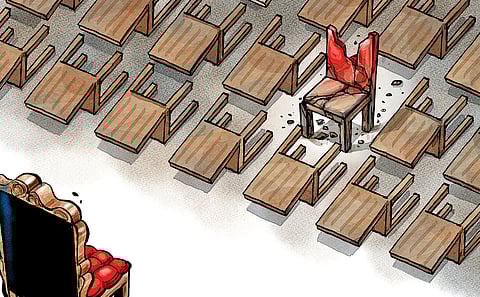

Those who live by the sword, die by the sword. The journey of Jagdeep Dhankhar, former Vice President of India, in some sense, reflects the nature of contemporary politics. Dhankhar has been a temporary resident of many political parties. He initially joined the Janata Dal and was elected to the Lok Sabha from the Jhunjhunu constituency in 1989. He soon joined the Congress, contesting the 1991 general elections from Ajmer. He lost. However, he succeeded in getting elected to the Rajasthan Assembly. In 2008, he joined the BJP. Opportunism in politics provides a springboard to success. Here, he found his peace.
We call ourselves a democratic Republic, but neither democracy nor the fundamental tenets of Republicanism are reflected in today’s politics. There was a fleeting semblance of that years ago, but today, it is completely effaced.
Dhankhar was catapulted to the office of Governor in West Bengal. There, he acted as the spokesperson of the BJP. He left no stone unturned to tarnish the TMC’s reputation, and worked at the behest of the Union government to destabilise Mamata Banerjee’s regime. The BJP’s initial agenda seemed to gain traction, but Mamata came up trumps.
The BJP has been seeking a foothold in several states, including Tamil Nadu, Kerala, West Bengal, Andhra Pradesh and Telangana. But for their sizeable presence in Karnataka, they found themselves forlorn in several southern states. Dhankhar, having demonstrated both his mettle and loyalty, the Modi-Shah duo found him to be a convenient accessory to their agendas. He turned out to be more loyal than many votaries of the BJP. This catapulted him to the office of Vice President. The ‘kisan putra’ eventually found himself chairing the Rajya Sabha.
The concentration of power in the hands of the Chairman and the manner of its exercise are reflected in the proceedings of the Rajya Sabha. The suspension of opposition members, instances of switching off their microphones, and the open bias reflected in the allocation of subject matters to be raised and discussed in the House are all matters of record.
The frequent public articulations of the Vice President questioning the theory of the Constitution’s ‘basic structure’ and that the laws made by Parliament must get primacy within the constitutional framework, and reprimanding members of the House raising objections to and questioning the constitutionality of legislation initiated, are also reflected in the proceedings of the House. The Chairman’s conduct, both within and outside the House, often aligned with the BJP’s agenda and ideology. He frequently commented upon the necessity of enacting and implementing a legislative framework in which the power to appoint judges to the higher judiciary was vested in the government.
Despite all this, the Vice President resigned on July 21, 2025, citing alleged health reasons that prevented him from continuing in office.
It is pretty clear from subsequent events that the reason the Vice President resigned had nothing to do with his ‘precarious’ health, but rather with his actions, both known and unknown to the public. What is evident is that his announcement in the Rajya Sabha regarding the motion moved against Justice Yashwant Varma riled the government because the Lok Sabha, which was also seized of a similar motion by more than 100 Members of that House, had not dealt with it.
This appears to be the trigger point for the Vice President’s resignation, apart from other possible reasons that we may not be aware of. The meeting of the Business Advisory Committee held at 4:30 pm on the day of his resignation, not being attended either by the Leader of the House, or the Minister of Law & Justice, or, for that matter, the Minister for Parliamentary Affairs, was an ominous signal, a precursor to what was to follow. The fact that he has not been given a farewell, and that none in the BJP visited him to inquire after his health, along with the tepid tweet from the Prime Minister, suggested that the government was no longer in a mood to tolerate him.
Now that he has demitted office, the election to the office of the Vice President has to be held expeditiously. Under Article 68(2) of the Constitution, there is no fixed timeline within which the election must be held to fill the vacancy in that office. It must happen as soon as possible after the vacancy occurs. According to the Presidential and Vice-Presidential Elections Act, 1952, the Election Commission of India must notify the schedule for the election, and the process must conclude within a maximum period of 32 days. The law allows 14 days for filing nominations, followed by one day for scrutiny, and a two-day window for withdrawal of candidature.
Thereafter, the poll must be held not earlier than 15 days from the date of withdrawal. Taking this into account, the election cannot be held before 32 days from the date of notification of its schedule by the Election Commission of India. It is, therefore, quite clear that the election for the next Vice President would take place only after the end of the Monsoon Session on August 21, 2025.
What this tells us about the nature of our polity today is that this government will not tolerate those who act independently of its wishes. Those who do not fall in line, regardless of the office they occupy, will be dealt with in accordance with the government’s political will.
I wish the Vice President had the courage to stand up for the dignity of the office he held. That he was willing to sacrifice it and quietly resign, again falling in line with the dictates of his political masters, tells us as much about the man as the state of politics in our country. That he has chosen to do so will be remembered as one of the saddest days in the history of our Republic.
Kapil Sibal | Senior lawyer and member of Rajya Sabha
(Views are personal)
(Tweets @KapilSibal)