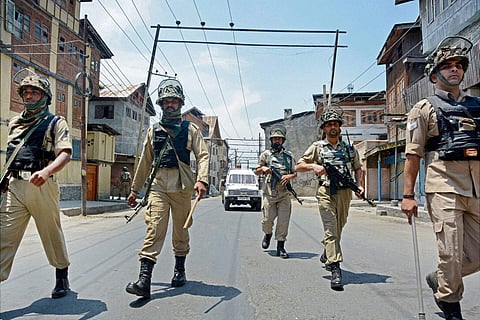

The induction of the Central Reserve Police Force (CRPF) into more and more VVIP/VIP security duties has created skepticism in the minds of at least some concerned internal security experts. There is no doubt that with its versatility and traditionally flexible operational procedures, if any Central Armed Police Force (CAPF) is to be depended on for this, the CRPF eminently qualifies for it. But the problem is the overstretching of its role and the consequent pressure on the force’s sanctioned strength
The CRPF remains one the major feeder organisations providing personnel to man both the Special Protection Group (SPG) and the National Security Guard (NSG) on deputation ever since their inception. This ensures that these elite organisations get the best personnel, that too when they are young, fit and at their best. It also provides greater professional opportunities and much-needed family life to hundreds of personnel deprived of static postings due to operational reasons.
So in a way, it suits both the borrowing organisations and the feeder forces. Collaterally, feeder forces like the CRPF have a vast pool of repatriated men with expertise in VIP security matters.
With the Central Industrial Security Force taking over parliament security, the Parliament Duty Group , a special unit of the CRPF hitherto dedicated to ensuring security to parliament, is also available to ensure security to political dignitaries whose NSG cover has been recently withdrawn.
So, apparently, the Centre’s recent decision to induct nearly 1,000 CRPF personnel on VIP duty should not cause any depletion in the level of its deployment for multiple internal security roles.
The security of dignitaries such as the leader of the opposition, taken care of by the SPG till recently, is already with the VIP Security Group of the CRPF. This group, comprising repatriated SPG and NSG men, has given a very good account of itself so far. Perhaps this prompted the government to draft 1,000 more personnel on VIP security. Such additional allotment, if done on an ad hoc basis without enhancing the sanctioned strength of the force, would definitely tell upon its core duties.
The normal battalions deployed on counter-insurgency, anti-terrorist and left-wing operations, already bearing the brunt of large-scale vacancies, will be facing further depletion if asked to detail manpower for supplementing the VIP security group. The force, living up to its motto of ‘service and loyalty’, never says no to any such daunting task.
During 2009-10, 10 Commando Battalions for Resolute Action (CoBRA) were to be raised and stationed in 10 different locations affected by extreme leftist violence. Nearly 10,000 young personnel with high physical standards were taken out of ordinary units that were already reeling under severe shortage. The emergency drafting into CoBRA created such a huge vacuum that it took years to fill the resultant vacancies getting accentuated by normal retirement and increasing attrition. Often the emergency drafting on such special assignments cannot be planned well in advance.
This is not to say the force is not ready or capable of meeting such contingencies. It is well-equipped to give the orientation and induction training to those drafted for VIP security duties at its facility. The talent pool of repatriated manpower is in abundance. Moreover, from a welfare point of view for the ‘chalte raho pyare’ force, it is a welcome respite as a few more rather static duties are coming up amidst overwhelmingly mobile tasks in multiple theatres of internal security challenges.
The extension of the scope of duties entrusted to the ‘force of all seasons’ is not compromising its core competency; on the contrary, it is complementing its legacy of versatility. The CRPF has proved its mettle in dealing with multiple internal security challenges and is doing equally well in subsidiary tasks from election duties to VIP security and all shades of law enforcement jobs. In fact, such diverse assignments are not only honing the professional skills of its personnel but also saving them from monotony and consequent rut of routine fatigue.
In a vibrant democracy, the threat to the life of political dignitaries cannot be ignored. The country may have to pay a heavy price for any lapse as the survival of the democratic system could be in jeopardy if anything goes wrong. There are domestic elements and external deep states out to destabilise our country. Maybe with the claim of Karnataka that they are free of Naxalites and the Centre eventually expressing the same confidence over other affected areas, we may be able to pull out more force personnel from such theatres and deploy them on VIP security duties.
Hopefully, with perceived improvements in the security scenario, a reshaping of the country’s security architecture without expanding the sanctioned strength of the CAPFs further is appearing to be feasible.
(Views are personal)
K V Madhusudhanan | Former Inspector General, CRPF; founder DIG, special operations unit, CoBRA; in charge of four former prime ministers’ close protection teams