
“It is better to discuss things, to argue and engage in polemics than make perfidious plans of mutual destruction.” — Mikhail Gorbachev, former President of the Soviet Union
Oil remains a weapon of consequence in the intriguing world of geopolitics. The EU’s adoption of an 18th package of sanctions is aimed at escalating economic pressure on Russia. Once they are rolled out, the financial and trade restrictions could rattle the global oil market and singe the authors of the directive as well.
Inhibiting oil and gas supplies from Russia, the second largest OPEC+ oil producer, will heat up energy prices. The price cap of $47.60 a barrel, effective from September 3, purports to strangle Kremlin’s revenues and weaken its military ambitions in Ukraine. An import ban on refined products derived from Russian crude January 21, 2026 onwards could lead to a high premium for oil out of West Asia.
However, the wider landscape reveals a different narrative. An estimated 5 million barrels per day of spare capacity with OPEC+ members could be configured to fill the gap. Kazakhstan, Iraq and the UAE have constantly exceeded quota allocations and plan to further raise production. Substantial new Caribbean and South American supplies will also hit the market early next year. Should the sanctions trickle down to the ‘Siberian supplies’, the fence-sitters will promptly fill the ensuing void. Thus, a price spike will be short-lived.
The present round of restrictive measures could be far less effective to attain EU’s objective in the absence of US support via secondary sanctions. Complexities surface as Beijing engages with Moscow and Tehran in the energy sector. India continues to patronise Russian oil in tune with a judicious economic agenda. America’s keenness to increase its presence in the Chinese and Indian markets—the two largest consumers—could propel Washington to restrict Moscow’s flows, leading to cost pressures.
However, the dilemma is that astronomical premiums would render Washington susceptible to inflationary woes, while, at substantially lower prices, US shale would ‘underperform’. It will be a tightrope walk to balance prices in such fluidity. Only a sustainable equilibrium will usher in new activity in the Permian basin, facilitating Asian imports from the US, and initiate favourable trade ties for Washington.
Crippling sanctions on Venezuela over the last two decades have throttled the OPEC member that’s the largest holder of proven reserves in the world. US major Chevron is active in the South American country since 1923 and, despite US sanctions, was accorded a short reprieve during Joe Biden’s presidency after Nicolás Maduro’s re-election. Last week’s approval by the White House of Chevron’s restricted involvement is a move to resurrect the supply of Venezuelan heavy crude to US Gulf Coast refineries.
However, deteriorating infrastructure, mismanagement and lack of investment have hampered revival of the ailing Venezuelan state oil company, PDVSA. The latest move hints at leveraging America’s share in Asian demand. The sanctions were rendered ineffective to an extent as independent refineries in India and China patronised Venezuelan oil from the Orinoco belt, as they are specialised to refine the heavy crude. China continues to import oil from Venezuela in an arrangement to pay off Caracas’s debts. About two-thirds of the oil exported by Venezuela in 2023 landed in China via Malaysia.
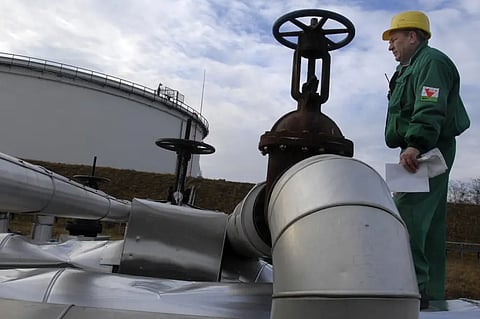
China also imports more than 45 percent of Russian crude, a significant portion of which is carried through the Eastern Siberia-Pacific Ocean (ESPO) and other pipelines such as Skovorodino-Mohe and Atasu-Alashankou. With over 2 million bpd of Russian oil entering Chinese territory, it will continue to be an important bridge in their trade alliance. ESPO pipeline facilitates Russian exports to Japan and South Korea, too.
Historically, oil has been covertly transported on the high seas via ‘shadow and dark fleets’. Though restrained conveyance through secondary sanctions could exacerbate the pain and impact supplies to an extent, surface transportation shall continue to provide succour for Kremlin’s fossil fuel exports.
Sanctions get easily watered down by convenience. In an earlier column, I had mentioned the restrictions and embargoes ‘adjusted’ in the past and tailormade for specific needs of some EU nations. Continuing the pattern, Budapest intends to proceed with the building of a new pipeline between Serbia and Hungary, facilitating Russian crude imports. Last week, Bratislava extended an agreement with Moscow to continue to receive “economically advantageous” gas supplies from Gazprom until 2027, even while Brussels attempts to shut off Kremlin’s energy ingress.
The energy equation is evolving and natural gas is viewed as an ethical alternative to oil in the future. But within that alternative, it’s imperative to accept the role of present actors. With Moscow’s noticeable share in natural gas, LNG and coal supplies to Europe, the UK and EU need to adopt a long-term view, lest the sanctions’ tremors destabilise their energy sufficiency goals.
Depleting reserves and rising costs of extraction in the existing North Sea fields have impacted oil production in the UK. BP and Shell continue to pursue exploration and production in parts of Africa though the region’s geopolitics continues to be volatile. Any tightening of the market will entail a shrewd calibration to manoeuvre the pitfalls.
In October 1939 as Winston Churchill said, “Russia is a riddle wrapped in a mystery inside an enigma”, he was prescient of what would follow decades later, too.
Ranjan Tandon | Senior markets specialist and author
(Views are personal)