
The parallel analysis of some key indicators reveals a sharp and persistent divergence in India’s growth story. The National Statistics Office’s Index of Industrial Production for September 2025, when combined with the RBI’s Industrial Outlook Survey for July-September 2025, highlights a troubling conflict. Industrial growth is being vigorously driven by investment and capital goods, but is being held back by uneven household demand, particularly in mass-market segments.
Simply put, while metal beams, electrical machinery, and motor parts are accelerating India’s industrial complex, the underlying sentiment paints a picture of a ‘divided engine’. Investment is thriving, supported by policy and corporate confidence, but mass consumption is disturbingly lagging. This divergence presents a central challenge to policy makers: how to synchronise these two disparate growth trajectories and ensure the current investment boom translates into inclusive prosperity.
Headline figures confirm industry’s structural resilience. The IIP grew 4 percent this September. The manufacturing sector contributed much of this growth, expanding by a respectable 4.8 percent. Within this, high-weight industries—notably, basic metals and electrical equipment—acted as the primary accelerators, strongly signalling active industrial investment and infrastructure activity.
IIP’s ‘use-based’ classification helps us distinguish clearly between long-term capacity creation and immediate consumer behaviour. The 10.5 percent surge in infrastructure and construction goods reflects a strong policy dividend arising from continued government capital expenditure.
This public spending acts as a powerful counter-cyclical tool, generating demand for fundamental industrial inputs like steel and cement. Capex-led momentum is directly driving higher output for basic metals (12.3 percent growth) and electrical equipment (28.7 percent)—sectors that form the backbone of industrial capacity creation and productivity enhancement.
Crucially, the 4.7 percent growth of capital goods affirms that businesses view the infrastructure push as structural and enduring, justifying significant fresh investment commitments. This is perhaps the most optimistic signal: the private sector is de-risking its long-term bet on India’s growth potential. Furthermore, the strong 10.2 percent growth in consumer durables reflects entrenched urban affluence, with higher incomes confidently deployed toward discretionary, large-ticket spending. This investment focus, while crucial, also provides the context for the RBI’s optimistic survey results.
The central bank’s survey adds the manufacturers’ lens, offering structural relief and future-oriented confidence that helps understand this duality better. The survey reports easing pressures from the cost of raw material, financing cost, and salary outgo in July-September 2025-26. This reduction in input inflation and debt burden is a massive win for corporate balance sheets.
This is the key analytical connection: falling operating costs, combined with robust output in capex-linked sectors, directly implies higher profit margins and stronger financial liquidity for core industries. This explains how high-margin sectors like basic metals and auto components (which grew 14.6 percent) can sustain such high output and confidence, creating a virtuous cycle on the supply side.
The corporate mood regarding the future remains overwhelmingly optimistic. The RBI’s Business Assessment Index rose to a comfortable expansionary territory, while the Business Expectations Index for the subsequent quarter remained stable at a highly expansionary level. Manufacturers are confidently predicting improved demand conditions all the way into April-June 2026.
Underpinning this hope is the expectation that current infrastructure spending will eventually unleash pent-up consumer demand, supported by regained pricing power. Manufacturers anticipate the market will be resilient enough to absorb price increases, which is a critical indicator of genuine economic strength. Importantly, this long-term confidence is also reflected in a strong employment outlook, with the net hiring response projected to climb to 32.4 percent by April-June 2026. The industrial optimism, therefore, carries a human face, promising more jobs for the formal economy.
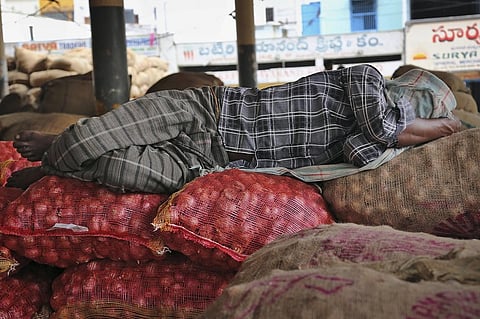
Despite the strong capex signals and buoyant corporate confidence, the consumption story stops abruptly at the consumer non-durables sector. This segment, encompassing fast-moving consumer goods and other essentials, serves as the most accurate barometer for rural and mass-market consumption health.
The -2.9 percent contraction in this category is the most concerning data point, pointing to systemic mass-market stress. It suggests that, at the margin, households are actively shrinking their spending on essentials or postponing critical, small-ticket purchases. This implies that the trickle-down impact of the capital expenditure boom has either been minimal or entirely negated by persistent cost-of-living pressures and structural issues in wage growth.
The contraction fundamentally challenges any claim of a broad-based economic recovery. If basic necessities are being curtailed, it points directly to an intensifying K-shaped recovery.
The combined reports confirm that the economy is indeed stuck between two gears. One, driven by structural reform and capital investment, is producing double-digit growth in infrastructure and durables. The other gear, representing the bulk of India's population and mass consumption, is fundamentally constrained by income uncertainty.
For the Centre and the RBI, the primary challenge has evolved from merely igniting growth to ensuring its parity. The current strategy of relying heavily on government capex and banking on the trickle-down effect has succeeded in bolstering the supply side. However, sustaining overall growth at high levels, which inevitably requires domestic consumption, now demands direct intervention in the consumption engine.
Policy makers must deploy targeted measures to boost disposable income for the majority. This intervention cannot rely solely on the expectation of future job creation, but address immediate needs too. The policy tools include direct income support or targeted transfers, accelerated public works, and supply-side price management.
If the high confidence reflected in the RBI’s survey—the certainty that costs are easing and job creation is imminent—fails to translate rapidly into tangible spending power for the vast non-durables consumer base, then India risks sustaining a robust economy that serves only half its population. The divided engine needs to be synchronised urgently. Otherwise, the powerful capex-led prosperity will remain an elite phenomenon. Ultimately, India’s industrial momentum will endure only if investment-led capacity creation converges with broad-based consumption revival, transforming structural strength into shared prosperity.
Tulsi Jayakumar | Professor, finance and economics, and Executive Director, Centre for Family Business and Entrepreneurship at Bhavan’s SPJIMR
(Views are personal)