
Hours before his October 30 meeting with Xi Jinping, Donald Trump announced that he had instructed the US department of war to “start testing nuclear weapons on an equal basis” immediately. He reiterated the stance in an interview later: “We’re going to test nuclear weapons like other countries do.” He also accused Russia, China, North Korea and Pakistan of conducting deeply buried underground nuclear tests.
Trump’s remarks came in response to Russia’s testing of new nuclear delivery systems—the Burevestnik, a nuclear-powered cruise missile tested on October 21, and the Poseidon, a nuclear-powered torpedo tested on October 28. His instructions were directed to the US department of war, which oversees missile testing, rather than at the department of energy, the principal authority for nuclear-weapons testing.
The day after the Trump-Xi summit, the US energy secretary clarified that the administration’s reference to renewed testing concerned ‘system tests’—that is, subcritical experiments intended to verify the performance and reliability of existing nuclear weapons.
However, Trump’s ambiguous statements have stirred considerable uncertainty and debate within the non-proliferation and arms control communities, while also prompting reactions from the countries he accused of conducting nuclear tests.
At a meeting with the Russian Security Council on November 5, Vladimir Putin, while reaffirming that Moscow would only restart nuclear tests if the US initiated them, instructed his officials to prepare formal proposals for a potential resumption of tests. Russia also publicly urged the US to clarify what it called “contradictory signals” regarding the resumption of nuclear testing.
China’s response was restrained. Beijing expressed hope that Washington would abide by its 1996 commitments to the Comprehensive Test Ban Treaty (CTBT), maintain its moratorium on tests, and actively safeguard the international nuclear disarmament and non-proliferation regime. Pakistan denied testing, while North Korea offered no immediate response.
The CTBT, which explicitly prohibits nuclear explosions, was signed by the US, Russia, and China on the very day it opened for signature in September 1996. While Russia ratified the treaty in 2000, it later withdrew in 2023, citing the asymmetry created by the fact that the US had signed but failed to ratify the agreement. Although China has also not ratified the CTBT, all three nations have maintained a stated policy of moratorium.
India chose not to sign the treaty, with a senior diplomat declaring, “India will not sign this unequal treaty. Not now, not ever.” This decision was taken to safeguard our security interests, preserve our sovereign decision-making, and reject a framework that perpetuated the privileges of the established nuclear-weapon states.
Nevertheless, following the 1998 Pokhran tests, India voluntarily declared a unilateral moratorium on further testing as a demonstration of restraint and responsibility.
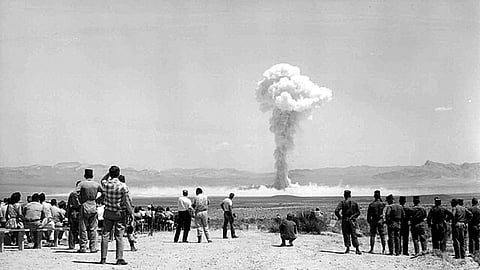
While the term ‘nuclear testing’ may conjure images of mushroom clouds and fiery explosions, modern research has evolved far beyond. Having conducted 1,030 nuclear tests before the advent of the CTBT, the US launched the Stockpile Stewardship programme in 1994 to ensure the safety, security and reliability of its nuclear arsenal through subcritical experiments, computer simulations, and hydrodynamic testing.
Subcritical experiments, though they employ fissile materials such as plutonium, do not initiate a self-sustaining chain reaction, and thus produce no nuclear yield, placing them beyond the scope of the CTBT’s prohibition. Computer simulations and hydrodynamic testing do not involve any fissile material.
While the US asserts that it maintains full transparency in announcing its subcritical experiments, it has been accusing Russia and China of their lack of transparency including expansion of nuclear-testing facilities.
Given the extensive global monitoring network established under the CTBT, it is virtually impossible for any nation to conduct underground nuclear tests of significant yield without detection. It is, however, theoretically conceivable that Russia or China may have carried out ultra-low-yield experiments, though such tests are unlikely to yield meaningful advances in designing more sophisticated weapons.
Conversely, if the US were to resume underground explosive tests—a process estimated to take at least two years to implement—it would effectively grant China a free hand to expand its own testing programme. Unlike the US and Russia, which have conducted hundreds of tests, China had carried out only 46 before 1996. A return to full-yield testing would thus level the strategic playing field, enabling China to develop new generations of nuclear weapons.
During his first term, Trump sought to establish a trilateral framework with Russia and China to limit nuclear weapons—an initiative Beijing firmly rejected. Shortly after returning to office this year, he declared that denuclearisation would be a key objective of his second term. Following the Alaska Summit with Putin in August, Trump expressed optimism about Moscow’s willingness to engage in discussions on the issue, voicing hope that Beijing would eventually join the dialogue.
It appears that Trump was raising the stakes ahead of his meeting with Xi, even though no progress has been seen from the Chinese side thus far.
Yet, if Trump were to resume full-yield nuclear testing, it would not only doom the CTBT, but also risk unravelling the Nuclear Non-Proliferation Treaty, extended indefinitely in 1995 on the understanding that the CTBT would be concluded.
R Swaminathan | Former Governor for India to the International Atomic Energy Agency and former head of external relations at the Department of Atomic Energy
(Views are personal)