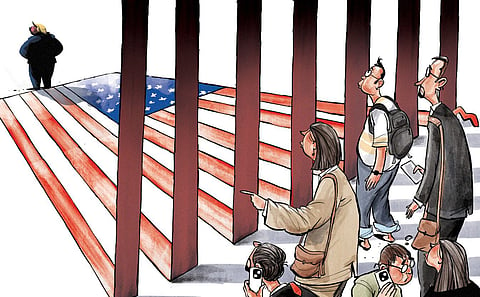

The week gone by ended with a bang. President Donald Trump decided to impose a stiff $1,00,000 fee for H-1B visa applicants. This move, in the wake of the 50 percent tariff that was imposed on Indian exports to the US just recently, seemed to be a double whammy of sorts. The good part: the White House seemed determined to ensure that American jobs were secure. The bad part: the American dream of many a young Indian wanting to make a career in the US seemed a bit shaken, if not stirred and decimated altogether.
There was chaos for an entire day. Amid the confusion of understanding the fine print of the presidential order, companies sent out advisories to their employees to return to the US immediately by September 21 to avoid the risk of not being allowed to re-enter. Social media videos of those just about leaving US airports wanting to de-board out of sheer fright made the news. There was panic and uncertainty in the air. The US had dropped the H-bomb— the H-1B visa bomb. The American dream could not be taken for granted. The times were uncertain.
The US administration clarified quite quickly in a day that existing visa holders need not worry. That was calming for those with a visa on hand. Only those who sought new visas and those that came up for the next round of lottery were the ones who would have a big fee to pay. Companies bringing in overseas resources to work in the US were being told to bring in only high-value-added human resources. Folks you were willing to pay a stiff fee to bring in.
President Trump does not want you to replace lower-end American jobs with the Indian or Chinese import. He even went about quoting the case of a company that sacked more than 20,000 American workers to bring in just about that number of overseas employees at a lower cost. Trump seemed fine with “brain-shopping” at the top end, but seemed staunchly against “body shopping”, something that has been the very foundation of the Indian IT end-to-end services industry. He wants to put an end to this, and hence the plan.
This action on the H-1B visa seems to be part of this plan. The key idea is the noble intent of protecting American jobs. From the Indian side of the fence, all that was well, but this is a business challenge. One that will make Indian IT exports uncompetitive. This is not to be for the Indian company alone, but for some of the biggest American companies as well that bring in Indians to work for them on American soil. The data throws up names of some of the biggest American companies on the list—Amazon, Microsoft, Meta, Apple and Google included.
The double-whammy perception of it is, however, the fact that Indian imports were being taxed, both of the goods and the human kind now. India was certainly at the receiving end of this order, as 71 percent of the approved visas (of the total 85,000 H-1B approvals) went to Indians, with China coming a distant second with 11.7 percent. The pressure was clearly on India and Indians. The world is getting less flat all of a sudden. Nations are getting protective and the MAGA agenda in the US is not a force to be ignored. India and the Indian are under pressure. The US is no longer the land of milk and honey for us to drink from.
What then is the India response? What must it be? As I ask this question, there is a fair bit of chaos and lack of clear thinking in the industry. The government response is yet to come, as the diplomacy back-channels must be working overtime. The people’s response is loud and chaotic though, as it usually is. Our television channels are full of ‘quick-gun Murugan’ responses. Everyone is aghast and irritated. Everyone is against the US actions.
And then there is a fair bit of crisis-romanticism at play here. People who just don’t know the business reality at play are suggesting political motives with solutions that talk of things that seem just out of a Mills & Boon business romance series, if there ever was one. An entire reverse brain-drain on the US with our Indian doctors and scientists and engineers returning home to work for India, in India is one of them.
As the Indian response is shaping up, what can we do? I do believe when a nation is pushed, it pushes back. This pushback has begun. When pushed against the wall, you need to survive and fight back. Indian IT houses need to think this out carefully. The writing has always been on the wall and internal think tanks within companies have always ideated on this possibility. Our scenario-planning exercises have always visualised this eventuality. This is nothing new.
Our IT-led and -enabled enterprises have, over the years, hedged their bets across geographies. What started as a US-need-centric business is today hedged across geographies. India works across the world. Yes, the US is still the biggest market, but it certainly is not the only market. In that manner of speaking, an Amazon will face the bite of this action more than a TCS. The business response will, therefore, come from the biggest of American firms that use and depend on Indian resources.
When the resource cannot come to the company at economic cost, must the company go to the resource then? Therein lays a salivating thought for India. I do believe action on this will come from American companies and not by hands-tied Indian ones. In the beginning, they will test the legality of this presidential action, and if it holds, I do believe business will go where it makes sense to go. The large number of global capability centres (GCCs)—1,900 at the last count—that have made Indian soil their home are examples of how businesses go where it makes sense to go. These GCCs have been set up in India not only because India is hungry for them (that as well). They are here because they are hungry for India and what it offers them. It makes excellent business sense to be at the centre of talent. Either go where the talent is, or like in the old days, bring the talent in. That paradigm will change and there lays the big opportunity for India.
Yes, a lot of our youngsters will lose the opportunity to live in the US and enjoy the American life and lifestyle, but home is where the heart is. My Bengaluru has bad traffic, but it’s not all that bad. We get the best dosas out here at prices that astound, particularly when you convert the dollar to the rupee. Come to Bengaluru.
Harish Bijoor | Brand guru & founder of Harish Bijoor Consults Inc
(Views are personal)
(harishbijoor@hotmail.com)