Blame policy failures, not the courts

I am not entirely thrilled with how the judiciary functions in terms of its recent decisions affecting the country’s polity, nor am I a great votary of the processes and procedures the higher courts follow in respect of listing and disposing of matters. I also believe that the problems in the functioning of the collegium system of appointments to the higher judiciary need urgent attention.
However, it came as an utter surprise to me when Sanjeev Sanyal, the former Principal Economic Advisor to the Government of India and now a member of the Economic Advisory Council to the Prime Minister, went on a diatribe against the judiciary recently, alleging that the judicial system in our country was the single largest roadblock to rapid economic growth and for India becoming Viksit Bharat. He lamented the judiciary’s inability to enforce contracts in time and to deliver justice. A major overhaul in the judicial ecosystem was the need of the hour, he said.
As far as infrastructure development is concerned, the government, he said, will manage that. He claimed that unless the legal system is aligned to deliver at a rapid pace, no matter what happens in other parts of the economy, we will never be able to achieve our goal of Viksit Bharat, and that our legal processes need to be radically changed, including the need for a cultural transformation. He argued that instead of the judiciary congratulating itself for what it has done so far and blaming our colonial legacy, it needs a radical transformation.
He referred to recent developments in relation to mediation, saying that it is not a solution to the economic problems we face; mandatory mediation in commercial disputes creates problems and delays resolution of disputes, and that 98–99 percent of mediations fail. I was delighted to note that he believed that merit should be the basis of appointments to the higher judiciary.
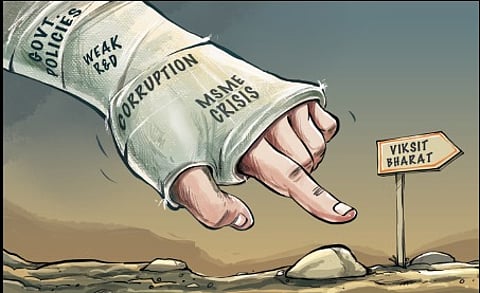
I fully appreciate Sanyal's concern about the functioning of the judiciary. However, I do believe that the pace at which this government has acted since 2014 to achieve the goal of Viksit Bharat, which we are all dreaming of, suggests that the government’s abject failures are being blamed on the judicial system. Regarding meritocracy in appointments to the higher judiciary, Sanyal should look within as to how the appointment processes are being interfered with and how political considerations weigh heavily in making such appointments. Meritocracy is being jettisoned, and independent judges are being penalised for their forthright judicial pronouncements.
As far as economic growth is concerned, Sanyal congratulates himself by publicly stating that India is the 4th largest and the fastest-growing major economy in the world, and that in the years to come, it will be the 3rd largest, without disclosing publicly what the per capita income of our country is. The fact is that it is the lowest at $2,880, even amongst the BRICS countries {China $13,690, Russia $14,260, Brazil $9,960, and South Africa $6,400}. I hesitate to compare the per capita income of our citizens with that of Europe, the USA, Australia, Japan and Canada. Surely, the judiciary is not to blame for the laggard economic growth. I believe that 6 percent growth is easily achievable due to domestic demand, given our population size.
Sanyal must inform us what this government has done in the last 11 years to give an impetus to research and development (R&D) in this country, given the fact that its annual spend on R&D is to the tune of $71 billion as opposed to $783 billion in the US and $723 billion in China. Unless you create wealth through innovation, which can only happen in the university system, India can never achieve the goal of Viksit Bharat.
Indeed, if you start appointing vice-chancellors with ideological commitments and subject the education system to executive interference, that, to my mind, is the real roadblock to economic growth. Economies around the world have thrived only when their education system, especially at the university level, is vibrant, not based on ad hoc teaching faculty.
Discussing smart cities and infrastructure development, I would like to ask Sanyal how many such smart cities have been showcased over the last 11 years. In fact, Sanyal should know by now that private investment in the country is lagging due to the nature of policies that this government has embraced since it came to power in 2014. Laws, which should have no place in any civilised society, are not only being enacted without following due process but are also being used to target opposition leaders, the business community, and all those who are critical of this government’s policies. Lakhs of high-net-worth individuals have exited this country.
Irrational decisions by this government, such as demonetisation, mishandling of the traumatic situation arising from the Covid-19 pandemic, and the irrational GST structure introduced in 2017, sought to be corrected without understanding their consequences, have negatively impacted economic growth. The toppling of elected governments at the instance of the BJP, the agenda of hate, bulldozer justice, and targetting a particular community may serve a political purpose but inevitably have economic consequences.
The prevailing oligarchic economic architecture, rampant corruption, the decimation of MSMEs, and the dismal state of the unorganised sector are all impediments in our journey towards a Viksit Bharat. The digital economy has served us well, but the travails of millions steeped in poverty must be addressed, without which Viksit Bharat will be a distant dream.
The five obvious pillars on the strength of which the economy will gain momentum are: Investment in human capital through quality education and healthcare, innovation through investments in R&D, freeing up the suffocating business environment with business-friendly laws and regulations, sustainable development by aligning environmental concerns with infrastructure projects, and encouraging FDI by providing certainty of outcomes. The aim is for an egalitarian society that respects diversity as a source of strength. If the government follows this path to progress, Sanyal won’t have to blame the judiciary.
The judiciary must also act consistently with our societal values, uphold the Constitution and the laws in their true spirit, and deliver justice without fear or favour.
Kapil Sibal | Senior lawyer and member of Rajya Sabha
(Views are personal)
(Tweets @KapilSibal)