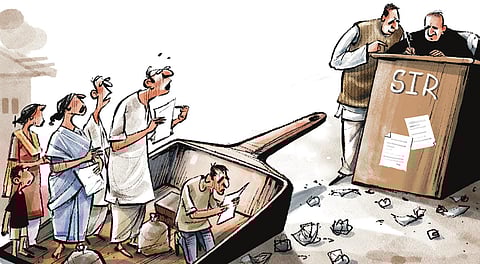

The Election Commission of India’s special intensive revision (SIR) in Bihar constitutes nothing less than a systematic deconstruction of universal suffrage, the sine qua non of democratic legitimacy. This mechanised disenfranchisement, masquerading as bureaucratic rectitude, represents a constitutional trespass. Its jurisprudential malignancy demands not mere critique, but forensic evisceration.
The bedrock of India’s electoral democracy is Article 326 of the Constitution. Its language is unambiguous and deliberately restrictive: “The elections... shall be on the basis of adult suffrage; that is to say, every person who is a citizen of India and who is not less than 18 years of age... and is not otherwise disqualified under this Constitution or any law made by the appropriate legislature on the ground of non-residence, unsoundness of mind, crime or corrupt or illegal practice, shall be entitled to be registered as a voter.” The term ‘shall be entitled’ creates an indefeasible constitutional right, placing the burden of disproving eligibility squarely on the State.
This formulation crystallises four immutable principles. First, suffrage is the default constitutional status of citizenship. Second, disqualifications form a closed hermeneutic universe (expressio unius est exclusio alterius). Third, each disqualification requires judicial imprimatur—court declarations (unsoundness), legislative disqualification (corrupt practice), or quasi-judicial residency determination. Fourth, other agencies possess zero delegated authority to invent new exclusion criteria. The SIR commits constitutional lèse-majesté by substituting this framework with a documentary inquisition, transforming suffrage from a constitutional right into an administrative privilege.
The Representation of the People Act, 1950 (RPA) and the Registration of Electors Rules, 1960 operationalise Article 326. They provide the machinery for roll preparation and revision, but they do not—and constitutionally cannot—expand the grounds for disqualification beyond those in Article 326. Section 16 of the RPA parrots Article 326’s disqualifications verbatim, creating an impregnable statutory fortress. The Election Commission, through SIR, has created a rather spurious ground of ‘documentary insufficiency’ through executive ukase.
Section 19 of the RPA conditions registration solely on citizenship, age and ‘ordinary residence’. Section 20 defines ‘ordinarily resident’ as a factual determination based on intention and continuity of stay; it explicitly states temporary absence does not break residence. Nowhere does it mandate continuous documentary proof or empower the electoral registration officer to demand specific documents as a precondition for maintaining registration. Section 21, under which the commission is carrying out SIR, empowers the preparation and revision of rolls. Revision inherently implies updating and does not empower a blanket re-verification of all existing voters.
This exercise has converted the due process into a Kafkaesque gauntlet where the people are presumed guilty until proven innocent. This violates not just precedent but the spirit of the law—the ideal that separates civilisation from savagery, the fundamental jurisprudential principle that the burden of proof lies upon the one who declares, not the one who denies.
Rule 21A of the Registration of Electors Rules is the critical statutory pathway for deletion of names. Deletion can only occur if the ERO is “satisfied” an entry is to be deleted under Section 22 (correction due to error). It establishes a tripartite process: notice, summary inquiry and hearing. The rule implies the burden lies on the ERO to be satisfied of the grounds. The SIR perversely reverses this: it places the burden on the voter to proactively prove their continued eligibility. It replaces statutory ‘satisfaction’ based on evidence and a hearing with administrative fiat based on non-compliance with an extra-statutory demand for documents. Bihar’s dragnet, where booth officers demand 11 documents like feudal lords collecting tribute, perverts these safeguards into instruments of mass disenfranchisement.
The Aadhaar flip-flop is particularly damning. Section 23(4) allows the ERO to require Aadhaar for establishing identity, specifically for new applicants, or authentication of existing entries and identifying duplicate entries. Yet, the ECI, in the SIR, is rejecting Aadhaar as valid proof of citizenship. The government relentlessly pushed Aadhaar linkage for years, asserting its validity for identity in electoral laws to the extent of enacting this provision in 2021. Now, when potentially used to protect voters from wrongful deletion, the ECI suddenly deems it insufficient for ‘citizenship proof’.
It’s a bait-and-switch of monumental proportions, betraying citizens who complied with earlier state demands for linkage only to find that compliance now deemed worthless for protecting their right to vote. Demanding other citizenship proofs goes far beyond the statutory mandate and constitutional confines. It is an invention born of administrative overreach or political pressure, and is therefore void ab initio.
Every voter currently on the roll was included after a statutory process, a previous summary revision where claims and objections were invited. Their inclusion represented a final determination of eligibility under the law at that time. The SIR, by seeking to re-open this determination en masse, undermines the legal finality of the existing roll.
It implies that the ECI’s own past processes were flawed or incomplete, casting doubt on the legitimacy of every election conducted using rolls finalised before this SIR. If the ECI lacked the power to verify citizenship properly before, how can elections based on those rolls be valid? If it did verify, why is this invasive re-verification needed? The SIR creates a dangerous precedent for perpetual electoral insecurity.
The demand for documents disproportionately impacts marginalised communities—the poor, the migrant, the illiterate, those displaced by conflict or disaster, women lacking independent documentation, and minorities. These are precisely the groups whose democratic voice is most crucial and most easily silenced. The concerns about ‘doubtful voters’ and illegal immigrants, often stoked along communal lines, find fertile ground in certain political narratives.
The ECI, constitutionally mandated to be an independent bulwark against such pressures, appears complicit. It is allowing itself to be used as a tool for demographic engineering under the guise of electoral purity. If allowed to stand, the SIR grants the ECI a carte blanche to purge voter rolls before any election on invented pretexts, effectively deciding the electorate rather than letting the electorate decide.
To remain silent is to acquiesce to the slow death of universal adult suffrage in India. Suffrage is democracy’s soul, not an administrative chattel. To permit its bureaucratic dismemberment is to commit civilisational suicide. The Constitution’s architects did not birth a republic where voting rights expire at the altar of documentary technocracy and bureaucratic tyranny.