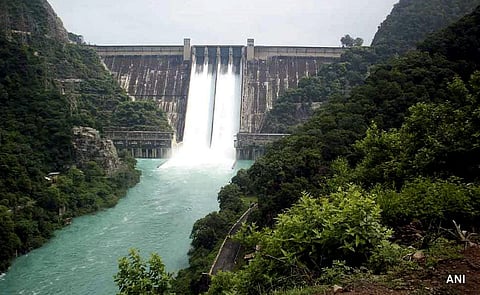

CHANDIGARH: For the first time since its commissioning, the Bhakra Dam is set to undergo a desilting operation, with sedimentation having reduced the storage capacity of the Gobind Sagar reservoir by nearly 25 per cent since 1963. The Union Jal Shakti Ministry has constituted a 10-member committee to oversee the process, following the Himachal Pradesh government’s in-principle approval to the Bhakra Beas Management Board’s (BBMB) proposal for desilting the Sutlej River at Bilaspur, upstream of the dam.
According to highly placed BBMB sources, the state government will now place the proposal before the Assembly for formal approval. If cleared, BBMB plans to conduct the desilting as a one-year pilot project.
Officials said the reservoir currently receives an estimated 38–39 million cubic metres (MCM) of silt annually, significantly higher than the originally projected 33–34 MCM. The dam was designed to handle 33.61 MCM of silt each year. Experts estimate that nearly 25–26 per cent of the reservoir has already been filled with silt. Though sediment is still about 10 km from the dam, the steadily advancing deposits are eroding its water-holding capacity. If unchecked, the reservoir’s capacity could shrink by 35–40 per cent by 2050, they warned.
Bilaspur has been identified as the most feasible site for the desilting operation because water levels there remain low for nearly eight months a year, making excavation easier. Its location along the National Highway Authority of India (NHAI) corridor also allows for smooth transport of extracted sediment. NHAI will be requested to use the excavated material for road embankments and earth-filling, potentially reducing construction costs.
As per the proposed revenue-sharing plan, proceeds from the mineral-rich silt will be divided among Himachal Pradesh, BBMB and the partner states. Himachal, being home to the dam and its reservoir, will receive the largest share, including standard royalties from sand mining, while BBMB will retain additional revenue.
Separately, BBMB has proposed a Rs 6,500-crore, 1,500 MW pumped-storage project as an extension of the Bhakra Dam at Dobar village, about five kilometres upstream from the existing structure. Planned under the public-private partnership (PPP) model on a build-own-operate basis, the project follows surveys that identified four viable sites across the reservoir.