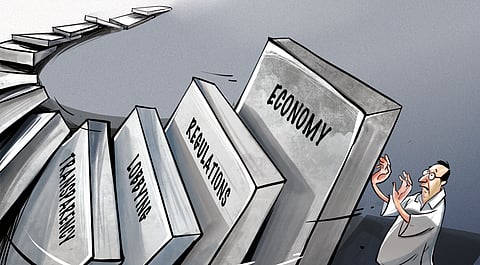

Stricter banking regulations known as Basel 3, introduced after the 2008 financial crisis to strengthen the global financial system, are now being systematically weakened. Understanding how regulatory ‘sausage’ is made gives insights into the problems.
Banks facilitate payments, accept deposits and provide credit and risk management tools. Deregulation and the drive for size and profitability have led banks to expand into underwriting securities, insurance, asset management and trading.
The risk of banking is simple. Unlike funds, banks guarantee the return of deposits. Losses from loans or other activities can jeopardise their ability to meet obligations. High leverage (10-12 times) exacerbates this risk. Banking involves maturity transformation. Deposits have shorter maturities than assets, meaning simultaneous large withdrawals create liquidity risk. Mismatches of maturities can expose the bank to rate fluctuations.
These risks can be addressed by less leverage with banks holding more capital, maintaining liquidity reserves and reducing maturity mismatches. Riskier activities, especially trading, can be restricted or supported by high levels of shareholder funds. Basel 3’s attempts to do this were unnecessarily complicated.
Equity, which encompasses many types of securities, is supplemented by a separate leverage ratio. Capital calculations often require arbitrary and subjective differentiation between risks. Banks must meet a liquidity ratio and net stable funding ratio. For off balance sheet instruments, like derivatives whose risks are difficult to estimate, there is a bewildering mix of central clearing, collateral and counterparty risk charges. Trading exposure is measured by complex formulas. Proprietary trading is theoretically restricted. Banks must prepare ‘living wills’, a funeral plan for unwinding transactions in the event of failure.
As Basel is an advisory forum, the rules must be adopted by individual jurisdictions. This creates a lack of uniformity. Some countries now require multinational banks to operate through appropriately capitalised local subsidiaries instead of branches. Rules are also adjusted according to size—sorted as globally and domestically systemically important banks. Whether the new system actually works is uncertain. The 2023 failures and resolutions of US regional banks and Credit Suisse required government intervention.
The causes of the dysfunction are straightforward. Banks wield significant power. By one count, at the end of 2023, 486 federal lobbyists were working on behalf of US banks with $50 billion or more in assets and seven trade groups were spending $85 million. Campaign donations run into hundreds of millions. The banking sector’s influence has strong foundations. With debt now central to economic activity, banks can unleash the potent threat that the availability of credit would diminish and its cost increase. Banks can rely on shareholders to support their objections.
In The Bankers’ New Clothes, Anat Admati and Martin Hellwig suggested much higher equity levels for banks—25 to 30 percent of assets (common a century ago) to decrease the risk of failures and crises. This 2-3 times’ increase in share capital would lower returns and earnings. Share prices would drop perhaps by 30 to 50 percent—a loss of even trillions of dollars in market value globally.
Bank tactics in avoiding or diluting regulations follow a simple script. They begin by arguing for self-regulation because banking is too complicated for regulators to effectively understand or control. If this fails, then they push for an inquiry involving multiple hearings, submissions, draft regulations and comment periods.
This incorporates the ‘salami slice’ tactic—you separate the issues and attack each sequentially, slowing the process. You aim to discredit even the most unobjectionable measures by association with more controversial elements. Lobbyists are skilled at obfuscation by switching between the entire package and individual components or sowing division between national regulators. Soon, regulators have lost sight of purpose, drowning in incomprehensible detail and confusing jargon.
If some regulation becomes inevitable, then lobbyists will helpfully draft proposed rules to assist ‘under-resourced’ policymakers. The aim is to make the rules complex, either vague or excessively long with ambiguous exceptions and exploitable contradictions. This creates endless possibilities for interpretation and loopholes that can be used to continue business as usual. The rules restricting proprietary risk-taking have exemptions for market making. Any self-respecting lawyer would be embarrassed if they cannot establish a client nexus to most trading to prevent application of the prohibition. New structures and products using loopholes present revenue opportunities for bankers.
Overly intricate regulations enjoy support from lawyers, advisors, compliance experts and consultants who benefit from detailed audit and oversight needs. Regulators can justify higher salaries, more staff and greater resources to administer the new system. In effect, simple effectiveness is inconsistent with profits or power.
Everybody knows that information asymmetry impedes proper regulation. Regulators struggle to obtain the best talent meaning they are ill-equipped for the task. Moreover, junior staff use their stints at regulatory bodies and central banks as a springboard into more lucrative careers in banking. This diminishes their zeal in challenging potential future employers. Senior regulators and politicians are unlikely to jeopardise futures as directors or advisors to the banks they now regulate.
As time passes and the original reasons that prompted regulatory scrutiny, typically a crisis or failure, become more distant, lobbyists argue that things are fine, the conditions that caused the problems no longer exist. They contend that any tightening can now be reversed. Exhaustion sets in. Personnel turnover allows you to claim the matter was discussed earlier, even if it wasn’t, and rejected.
Banks have used this approach to force regulators, especially in the US, to reduce the amount of capital required by banks. Amusingly, regulators continue to assert the banking system remains strong and resilient. That will be stress tested in the now brewing financial crisis. While taxpayers hope they are correct, there is no assurance the problems have been fully addressed and banks will pass the test.
The unacknowledged reality is that banks are utilities. Private ownership allows leveraged risk-taking underwritten by governments. This unpriced insurance effectively boosts bank returns benefitting shareholders at the cost of taxpayers. ‘Too big to fail’ financial institutions exploit the fact that the prospect of citizens unable to make payments or withdraw cash would bring down governments and paralyse the economy.
Satyajit Das | Former banker and author of The Age of Stagnation
(Views are personal)