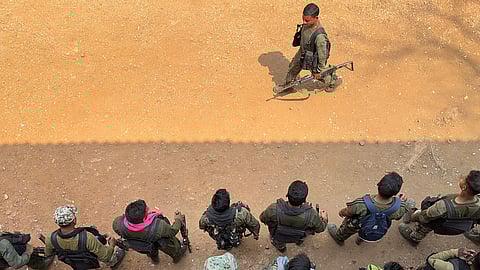

What originated as a protest over land issues in West Bengal’s Naxalbari developed into a highly violent revolutionary insurgency that killed a large number of security personnel, hundreds of civilians, and caused the loss of private and public property worth crores of rupees. By the mid-1970s, the original movement was decimated.
But things changed about two decades later. A March 2001 conference of the People’s War Group of the Communist Party of India (Marxist-Leninist), held at a secluded location in Dandakaranya, sought to create a common platform of Maoists and enlist the support of socially-oppressed classes. They sought to create ‘liberated’ guerrilla zones and a contiguous zone extending from Nepal to Karnataka and Tamil Nadu called the ‘red corridor’. From time to time, they also supported the secessionist struggles of Khalistan, the Northeast, Gorkhas, and Kashmir.
Acquiring military power, they unleashed terror across the country, compelling Prime Minister Manmohan Singh to concede that, by the second half of the 2000s, the Maoist menace had become the deadliest internal security threat. By 2010 end, they were able to demonstrate to the population of the ‘red corridor’ that it would be in their interest to toe the Maoist line or face consequences.
The security forces continued breathing down the Maoists’ neck, and political and administrative steps slowly made the movement less grievance-driven. The ideology never really mattered to the poor tribal communities, but only to the movement’s leaders, mostly from Andhra Pradesh and Telangana.
The creation of the Commando Battalions for Resolute Action or CoBRA at the Centre, modernisation of state police forces, and specialised training, followed by better coordination started yielding results.
This year witnessed a decisive upper hand for the security forces. The Union home minister’s deadline to get rid of the menace was perceived to be realistic and feasible, and it galvanised the countermeasures by multiple agencies. Operation Black Forest virtually broke the back of the movement with large-scale seizure of weapons and explosives, besides the killing of over 30 cadres including top leader Basavaraju, the brain behind several deadly strikes.
Since 2023, 401 Maoist cadres have been killed in encounters, 1,439 arrested and 1,356 surrendered. The impact was so substantial that Mallojula Venugopal alias Sonu, a surrendered central committee member, admitted that the armed struggle was no longer relevant. As more middle- and senior-level cadres leaders are surrendering, Maoists are now forced to abandon their traditional strongholds.
The killing of Madvi Hidma, the most formidable guerrilla of the movement, along with his trusted bodyguards and wife Madakam Raje, followed by the killing of seven other cadres and the arrest of 50 of them across Andhra Pradesh demolished the elusive image of the diehard guerrilla. Hidma, who joined the movement at age 16 and rose meteorically to assume control of its central military commission, masterminded at least 26 deadly strikes including the 2010 Dantewada assault that killed 76 CRPF personnel, the 2013 ambush that killed Mahendra Karma and a few other Congress leaders, the 2017 attack in Burkapal killing 25 CRPF personnel, and the Tekulguda ambush that caused 22 casualties among the security forces.
Tech-savvy but not formally educated, he had the great advantage over other leaders due to his command over the Gonda language as a Bastar native.
But moving to Andhra Pradesh proved to be his nemesis and the master tactician found himself unequal to the professionalism of the Greyhounds unit of the Andhra and Telangana police. He also underestimated the meticulous coordination among various agencies and states that had been perfected over a decade.
The suggestion of a ceasefire has been rejected by the Centre and the extremists have been urged to surrender. The concerned states have launched a rehabilitation policy under which protection and mainstreaming are to be ensured. This multi-pronged approach is likely to yield results and the declaration that India will be free of Maoist extremists by the end of March 2026 is likely to materialise.
But it will be foolhardy to assume that all will give in easily. Splinter groups, in their desperation, might indulge in mindless violence and retribution, as was seen in the case of killing of Inspector Ashish Sharma, a highly decorated Madhya Pradesh officer, on November 19.
Even otherwise, the Maoists are known to record their own setbacks and take corrective measures. Nobody imagined that the once-decimated movement would regroup and unleash relentless violence for close to two and a half decades in the new millennium. The only durable and long lasting solution will be removal of the socio-economic inequalities and mainstreaming of India’s large tribal population without bruising their sensibilities.
Regional imbalances should be addressed by distributing resources and development works. While providing infrastructure, ecological balance should be maintained and displacement should be avoided even if it is intended to create jobs. The security agencies should not lower their guard and should keep gathering intelligence.
The forces should also be encouraged to undertake civic projects in the affected regions and earn the trust of the local people. Remember, Left extremism has a history of rising from the ashes and regrouping at a tactically appropriate time.
K V Madhusudhanan | Former Inspector General, CRPF; founder DIG, CoBRA special operations unit; in charge of four former prime ministers’ close protection teams
(Views are personal)